


Most lifters may think they have a consistency problem, but the truth is they may have a structure problem. You’re showing up, putting in the work, and logging your sessions. But weeks pass and the squat rack is still loaded with the same plates. Fitbod’s Focus Exercise feature was built to help lifters drive progress on specific lifts. By designating a specific lift as your priority, you give Fitbod’s algorithm a clear signal to anchor your workouts around that movement, schedule it with proven training frequency, and apply systematic progressive overload automatically, so you can stop wondering whether you’re doing enough and start seeing the numbers move.
Key Takeaways
- Fitbod’s Focus Exercise feature pins a specific lift like the squat, bench press, or deadlift so the algorithm guarantees it appears in your generated workouts on a structured schedule.
- Focus Exercises trigger dedicated progressive overload programming on specific lifts, meaning Fitbod systematically advances your weight, reps, or intensity over time.
- The Focus Exercises feature is ideal for anyone with a performance goal on a specific movement, chasing a PR, or even beginners building a foundation.
- You can set a Focus Exercise in under 60 seconds inside the Fitbod app, and it works alongside Fitbod’s full AI-driven workout personalization.
1. What Is the Fitbod Focus Exercise Feature?
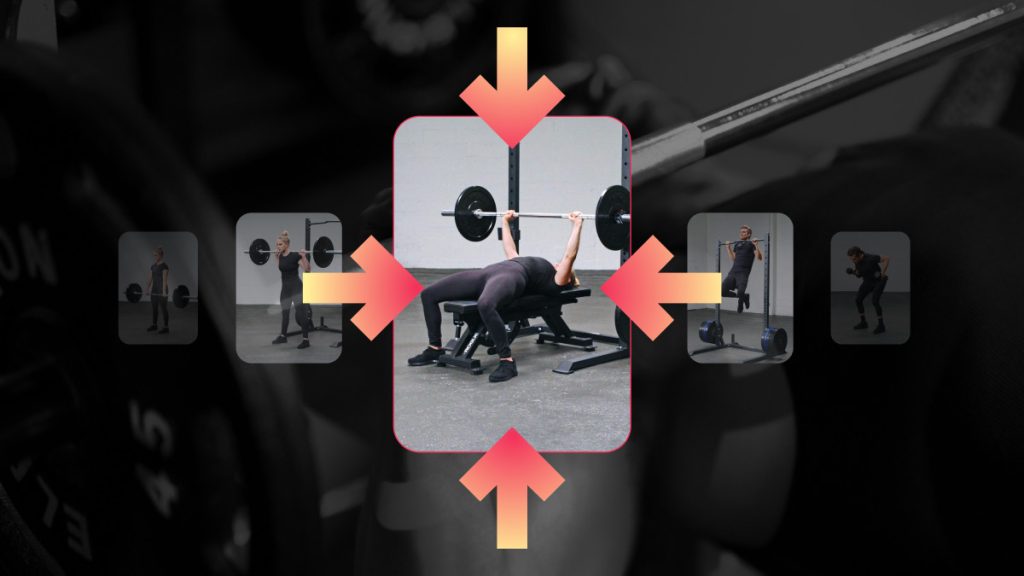
When you open “My Plan” in the Fitbod app and scroll down to Training Format, you’ll find an option to toggle on Focus Exercises. It does exactly what the name implies: it tells Fitbod’s algorithm that a specific exercise is your priority lift, the one you want to anchor your training around and make measurable progress on.
Unlike simply favoriting a movement or hoping it shows up in your generated workout, the Focus Exercise setting creates structured, deliberate programming around that exercise. Fitbod ensures it appears in your workouts with the right frequency and with progressively increasing weights over time.
Think of it as the difference between casually including bench press in your workouts versus following an actual bench press program. Focus Exercises give Fitbod the signal it needs to shift from general fitness optimization to targeted strength development on your chosen lift.
The feature is available to Fitbod subscribers on both iOS and Android, and it integrates seamlessly with the rest of the app’s personalization engine.
2. Why Most Lifters Stay Stuck on the Same Weights
Before diving into how Focus Exercises solve the problem, it’s worth understanding why so many gym-goers plateau in the first place.
Random programming is the enemy of progress. Some casual lifters may cycle through different exercises each session without a systematic plan for any of their lifts. They bench press on Monday, skip it for two weeks, then do it again. There’s no accumulation of skill, no progressive overload, no adaptation signal strong enough to force the body to get stronger at that specific movement.
Fitbod’s algorithm is designed to prevent this by tracking recovery, managing volume, and personalizing intensity but without a Focus Exercise set, the algorithm is optimizing for broad muscular balance across your whole body. That’s great for general fitness. It’s not always the fastest path if you have a specific lift you care most about.
There are three main reasons lifters stall:
- Insufficient frequency: A muscle or movement pattern doesn’t receive enough stimulus to adapt and strengthen quickly.
- No progressive overload plan: Without a structure for adding weight or reps over time, training volume flatlines.
- Skill deficit: Compound lifts like the squat, deadlift, and Olympic lifts are highly technical. You need repetitions across weeks and months to build the neural efficiency required to express your true strength potential.
Focus Exercises address all three.
3. The Science Behind Structured Progression
The evidence for structured, focused training is robust. Here’s what the research says and how Fitbod builds it into the Focus Exercise feature.
Progressive overload is the foundational principle of strength training. It means your workouts must become progressively harder over time: more weight, more reps, more sets, or less rest to continue forcing adaptation. Without a progressive structure, your body has no reason to get stronger.
Fitbod’s algorithm uses mStrength, its proprietary per-muscle performance measure, along with estimated 1RM (One Rep Max) calculations based on your logged set. When a Focus Exercise is active, this system sharpens its lens on that specific lift.
Frequency matters enormously for strength. According to the training science Fitbod is built on:
For strength development, training a lift at least once per week is optimal. More repetitions at a given movement pattern build both neuromuscular efficiency and structural muscle over time.
For hypertrophy, a minimum of 10–20 sets per muscle group per week drives growth, a target that’s much easier to hit consistently when a lift is pinned as a focus.
Skill acquisition requires deliberate repetition. Compound movements like the deadlift or overhead press aren’t just muscle exercises, they’re motor patterns. Research in motor learning shows that consistent, spaced practice of a movement across multiple sessions per week produces faster technical development than infrequent, high-volume sessions. Focus Exercises enforce this spacing automatically.
Periodization drives long-term gains. Fitbod uses undulating periodization, varying rep ranges and intensity across sessions, to prevent accommodation and keep your body adapting. With a Focus Exercise enabled, this periodization is applied specifically to your chosen lift, producing the kind of systematic overload that leads to real, measurable PRs.
4. 7 Ways Focus Exercises Help You Progress Faster
1. Guaranteed Frequency on Your Priority Lift
Without a Focus Exercise, your bench press might appear every 5 days or every 12 days depending on how Fitbod balances your full-body recovery. With one set, Fitbod schedules it with the frequency that best serves strength development.
2. Structured Progressive Overload Built In
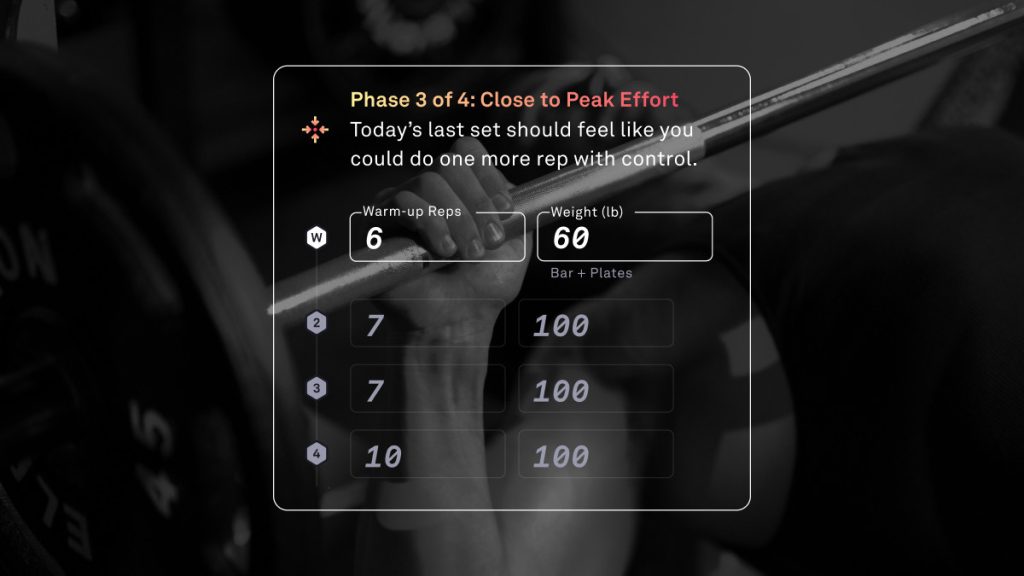
Fitbod’s algorithm tracks your performance on the Focus Exercise across every session. If you’re consistently completing reps above the target range or logging low Reps in Reserve (RiR), Fitbod advances your weight. If you’re struggling, it lightens the load. This is the same logic that a good coach uses applied automatically at scale.
3. Smart Volume Management
One of the mistakes lifters make when they want to “focus” on a lift is simply doing more sets every session until they burn out. Fitbod doesn’t just pile on volume; it distributes it intelligently across your week, with recovery awareness and avoiding excessive volume that doesn’t contribute to adaptation.
4. Preserved Full-Body Balance
Here’s what makes Fitbod’s approach different from running a dedicated single-lift program: the rest of your workout still gets programmed. Fitbod anchors the Focus Exercise in your session, then fills the remainder with intelligently selected exercises based on your goal, equipment, and recovery. You get dedicated focus AND full-body training – not an either/or tradeoff.
5. Training Splits That Make Sense
If your Focus Exercise is a lower-body compound like the squat, Fitbod will logically schedule it on lower-body days. If it’s a push movement like the overhead press, it appears in push sessions or full-body workouts on push days. The feature integrates with rather than fights against your chosen training format.
6. Objective Progress Tracking
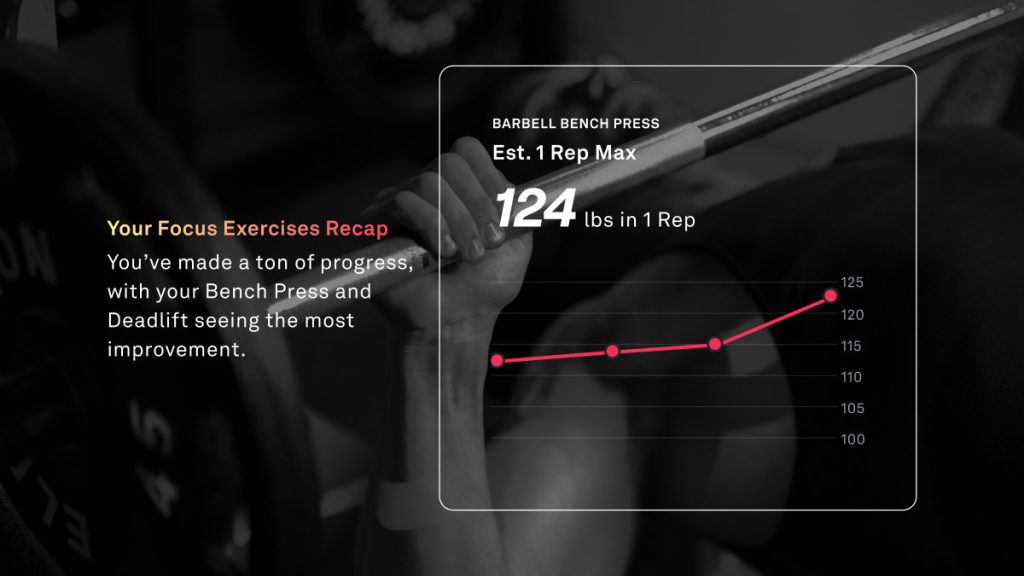
Because the Focus Exercise appears consistently, Fitbod can track its estimated 1RM progression over time and display it in the Results section of the app. You’ll see concrete data on whether you’re moving in the right direction, weight on the bar, estimated strength, PRs rather than guessing.
7. Reduced Decision Fatigue
One of the underrated benefits of the Focus Exercise feature is that it eliminates a common source of gym-session anxiety: “Should I squat today or save it for later in the week?” When it’s a Focus Exercise, the decision is already made. You show up, Fitbod has it scheduled, and you execute.
5. How to Set Up a Focus Exercise in the Fitbod App
Setting up a Focus Exercise takes less than a minute:
- Open Fitbod and tap the My Plan tab (top left navigation).
- Scroll down and tap Training Format.
- Select and toggle on Focus Exercises. If you do not see Focus Exercises as an option, you may need to change your Goal setting in the app.
- Browse or search for your chosen exercise (e.g., “Barbell Back Squat”).
- Select it and confirm.
From your next generated workout onward, Fitbod will begin incorporating your Focus Exercise with structured intent. The more you log, the more precisely Fitbod tunes the programming to your current performance level.
Pro tip: Make sure your equipment settings accurately reflect what you have access to. If you set a barbell back squat as your Focus Exercise but don’t have “Barbell” selected in your equipment list, Fitbod won’t be able to include it. A quick audit of your equipment profile before setting a Focus Exercise ensures everything works as intended.
6. Best Exercises to Use as a Focus Exercise
Not every exercise is an equally good candidate for Focus Exercise designation. The best choices share a few traits like compound movements that reward consistent practice, exercises that are central to your goal, and lifts that have clear, measurable benchmarks.
Top exercise candidates by goal:
For strength and powerlifting:
- Barbell Back Squat
- Conventional Deadlift
- Barbell Bench Press
- Barbell Overhead Press
For athletic performance:
- Power Clean
- Hang Snatch
- Romanian Deadlift
- Pull-Up / Weighted Pull-Up
For muscle building (hypertrophy):
- Barbell or Dumbbell Row
- Incline Dumbbell Press
- Romanian Deadlift
- Barbell Hip Thrust
For beginners:
- Goblet Squat (learning the squat pattern)
- Push-Up (building pressing foundation)
- Dumbbell Romanian Deadlift
Isolation exercises, like a bicep curl or lateral raise, can technically be set as Focus Exercises, but they tend to benefit less from the structured frequency model. Compound lifts, which recruit more muscle mass and have greater room for measurable load progression, are where Focus Exercises deliver the most value.
7. How Focus Exercises Work with Fitbod’s AI Algorithm
Fitbod’s algorithm normally makes exercise selection decisions based on a combination of factors: your goal, your equipment, your training split, recent workout history, and each muscle group’s recovery status (visualized on the Body tab as a color-coded recovery avatar).
When you designate a Focus Exercise, you’re essentially adding a high-priority constraint to this system. The algorithm now treats your chosen lift as a must-include in eligible sessions, adjusting the rest of the workout around it rather than optimizing exercise selection as if all movements were equal.
Fitbod still applies its full suite of intelligence to the Focus Exercise itself:
- Reps in Reserve (RiR) tracking: Your logged RiR data on the Focus Exercise tells Fitbod how close to failure you’re working, and it adjusts future intensity accordingly.
- Estimated 1RM: Your theoretical max on the lift is continuously updated based on your logged performance, and progression targets are derived from this.
- Dynamic rep range variation: Rather than the same scheme every session, Fitbod rotates through strength-focused and hypertrophy-focused loading even within your Focus Exercise, producing the undulating periodization effect that drives long-term adaptation.
- Warm-up integration: If you have warm-up sets enabled, Fitbod will include appropriate warm-up ramps for the Focus Exercise on days it appears.
This means you get the benefits of a dedicated program on your chosen lift without sacrificing the AI-driven personalization that makes Fitbod valuable for your full workout.
8. Focus Exercises vs. Just Doing More Sets: What’s the Difference?
A common instinct when you want to get better at a lift is to just add more sets. While volume is important, raw volume without structure is an inefficient and often counterproductive strategy.
| More Random Sets | Fitbod Focus Exercise | |
|---|---|---|
| Frequency | Inconsistent | Systematic, 2–3x/week |
| Progressive overload | Manual, easy to forget | Automated and data-driven |
| Recovery management | DIY | Built into Fitbod’s algorithm |
| Training balance | Often neglects other muscles | Full body preserved |
| Tracking | Manual or none | 1RM trends, PRs, volume tracked in app |
| Periodization | Usually none | Undulating (built in) |
The Focus Exercise feature doesn’t just add more of something, it adds structure, frequency, and progression tracking that raw volume lacks. That’s the difference between training hard and training smart.
9. Real-World Results: What to Expect
Real strength gains are a long-term adaptation and setting a Focus Exercise won’t produce transformation overnight. But with consistent use, you can expect:
- Weeks 1–4: Increased neural efficiency. Your technique improves, your reps feel smoother, and Fitbod begins accumulating enough performance data to fine-tune your progression.
- Weeks 5–12: Measurable strength gains. Most intermediate lifters see 5–15% increases in estimated 1RM on a well-structured lift over a focused 8–12 week block, per published training science literature.
- 3–6 months: Compound compounding. Because Fitbod tracks your history, each training block builds on the last. The estimated strength and PR data in your Results tab will reflect genuine long-term progress.
The key variables are consistency (showing up and logging every session), accuracy (recording actual reps and weights), and using RiR honestly. Fitbod’s algorithm is only as good as the data you feed it Focus Exercises are most powerful when paired with honest, thorough logging.
FAQs
Can I have more than one Focus Exercise at a time?
A: Yes. You can designate multiple Focus Exercises in your preferences. Keep in mind that the more exercises you prioritize, the more the algorithm is managing for most lifters, 1–2 Focus Exercises produces the clearest, most structured progression.
Will my Focus Exercise appear in every single workout?
A: Not necessarily every session, but Fitbod will schedule it at the frequency that best serves your goal typically 2–3 times per week for strength-oriented Focus Exercises, depending on your workouts-per-week setting.
Does the Focus Exercise feature cost extra?
A: No. It’s included with a standard Fitbod subscription, available to all subscribers on iOS and Android.
What if I want to change my Focus Exercise mid-program?
A: You can update your Focus Exercise at any time in your app under My Plan, Training Format. Changing it will signal to Fitbod that programming should shift to the new priority. If you’ve built up a meaningful training history on the old lift, that data remains in your account.
Can I set a bodyweight exercise as a Focus Exercise?
A: Yes. Pull-ups, push-ups, dips, and other bodyweight movements can be set as Focus Exercises. Fitbod will track volume and relative intensity (e.g., added weight, band assistance) to structure progression appropriately.
Does the Focus Exercise feature work with all training splits?
A: Yes it’s compatible with Full Body, Upper/Lower, Push/Pull/Legs, and Recovery-Focused formats. Fitbod will place the Focus Exercise in the appropriate sessions for your chosen split.
I’m a beginner. Is it too early to use a Focus Exercise?
A: Not at all. Beginners benefit significantly from consistent practice on a foundational lift. Setting one core movement as your Focus Exercise is an excellent way to accelerate both skill development and early strength gains.
Will using a Focus Exercise neglect the rest of my body?
A: No. Fitbod fills the remaining workout with intelligently selected exercises based on recovery and your overall training goal. Focus Exercises anchor a session; they don’t consume it.
Final Thought
Progress in the gym is rarely accidental. The lifters who consistently hit new PRs, build the physiques they’re after, and stay motivated over the long haul almost universally share one thing: they train with intention and structure, not just effort. Fitbod’s Focus Exercise feature is one of the most powerful and most underused tools in the app precisely because it delivers that structure automatically. You bring the work ethic; Fitbod handles the programming logic. Set your Focus Exercise, log your sessions honestly, and let the algorithm do what it’s designed to do. The gains follow.


