


 Click for the full report.
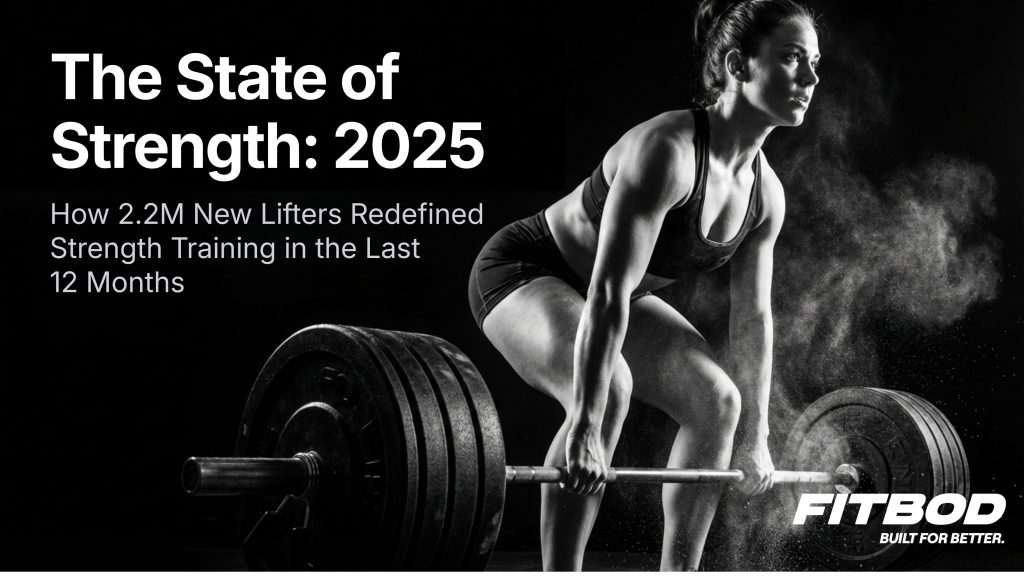
 How 2.2 million new lifters reshaped strength training in the last 12 months
Based on billions of real-world data points, Fitbod’s 2025 State of Strength report reveals how users trained with real life obstacles like changing schedules, multiple gym locations, limited time slots, and evolving goals to name a few. The result is a clearer picture of modern strength training that looks like consistency, adaptability, and smarter workout programming.
Below are the 10 most eye opening insights from the Fitbod 2025 State of Strength report, created for anyone serious about building strength that lasts.
Table of Contents
About This Report
Fitbod analyzed 71 million workouts, 2.8 billion lifting sets, and billions more anonymized data points logged between December 1, 2024 and December 1, 2025. All insights were generated from fully anonymized, aggregated data and evaluated by Fitbod’s in-house Data Science team, the Ph.D. kind, specializing in statistics and exercise science. This isn’t survey data, it’s how people actually trained.
Why We Publish the State of Strength
Fitbod published the 2025 State of Strength report to examine real-world resistance training patterns and trends at scale. By analyzing millions of structured workouts, we identified patterns in training adherence, load progression, workout timing, exercise selection, and strength outcomes that reflect how strength training is being practiced in real time. The result is a data-backed snapshot of today’s version of strength training with proof, not opinions.
1. In 2025, Strength Training Went Mainstream
The data tells a clear story: 2025 was a heavy year. Millions of new lifters entered the weight room, existing users trained more consistently, and strength gains followed. For Fitbod users, lifting wasn’t a hobby, strength training became a structured lifestyle habit. Over the course of the year, almost 2.2 million new Fitbod accounts were created, representing a 41% increase from 2024. Notably, 60% of these users were new to strength training, signaling resistance training as a possible entry point into fitness, not a secondary pursuit. Additionally, more than 511,000 women joined the Fitbod family in 2025, the equivalent of nearly 7 sold-out mega stadiums of women on a new path to strength this year, now that’s inspiring.
2. For the Next Generation, Muscle Is The Mission
For younger lifters, fitness is about more than staying active. In 2025, Gen Z and Gen Alpha Fitbod users trained primarily to build muscle, with 70% reporting ‘muscle hypertrophy’ as their main training objective.
3. Life Gets Interrupted But Progress Doesn’t Have To
A. Training Continuity Is Not Tied To One Location
In 2025, Fitbod users logged workouts across 1.6 million unique workout locations, with the average user training at 2.5 different gyms throughout the year. This pattern reflects a shift toward consistency, suggesting that progress follows commitment, not equipment availability. This flexibility allows lifters to maintain momentum through travel, schedule changes, and everyday life disruptions.
B. “Snack” Workouts Delivered Meaningful Progress
Progress persisted even when time was limited. In 2025, a subset of Fitbod users consistently trained in sessions of 10 minutes or less, often referred to as snack workout. Even with these abbreviated sessions, users still averaged 32 PRs over the year. These “minimum effective training” workouts helped to preserve momentum and consistency for users when full sessions weren’t feasible. Snack workouts appeared across all experience levels, reinforcing a key insight: When time is limited, adherence – not duration – determines progress.
4. Training Now Fits Around Life’s Obligations
Workout timing revealed a simple truth: people train around life, not in lieu of it. Users primarily trained before and after obligations, with weekday peaks coming in at 6 AM and 5 PM and weekend peaks at 10 AM. Strength training in 2025 didn’t demand perfect schedules, it adapted to real routines.
5. Consistency Is a Skill, Not A Trait
2025 Fitbod user data suggests consistency increases with experience – but it starts early.
- Advanced lifters: 65% consistency rate (2+ workouts/week)
- Intermediate lifters: 58%
- Beginner lifters: 52%
Fitbod data shows that training consistency rises with experience level. However, the strongest predictor of long-term progress is not experience – it’s early adoption. Users who trained consistently during their first three months achieved 3.6× more personal records (PRs) than those who did not. These findings suggest that consistency is not simply a trait developed over time; it is a habit established early on that compounds across the training lifecycle.
6. Accurate AI Is What Turns Workouts Into Results
Fitbod’s AI-driven training system demonstrated high predictive accuracy in 2025. That means Fitbod’s reps, sets, weights recommendations and estimated 1 Rep Max (1RM) values come in with extremely high accuracy, landing within an unprecedented margin at 2.8%. In other words, if your true 1RM is 100 lb, Fitbod’s estimate is within ± 2.8 lb.
In addition to accuracy, users who adhered to Fitbod’s AI recommendations achieved 24% more PRs in 2025. These results indicate reliable performance modeling and effective adaptive load progression across large-scale, real-world training data. Accurate, AI-enabled workouts precise enough to guide users and drive progress means confidence-based training without the guesswork.
7. Upper-Body Exercises Dominate, But Strength Gains Are Full Body
Training logs from 2025 reveal a familiar pattern: despite access to thousands of exercises, Fitbod users concentrated much of their training volume around upper-body movements. The most logged exercises of the year, in order, were:
- Dumbbell Bicep Curl
- Lat Pulldown
- Dumbbell Bench Press
- Hammer Curl
- Dumbbell Row
Yet the outcomes tell a more complete story. The top muscle groups of 2025 by strength gain were:
- Back
- Abs
- Quadriceps
These findings indicate that even with upper-body-skewed exercise selection, strength gains extended beyond the muscles trained most frequently. This reinforces the systemic nature of strength adaptation, where consistent training, progressive overload, and compound movements drive full-body improvements.
8. Different Paths, Same Destination: Strength
Training patterns showed that lifters took different paths toward the same goal: getting stronger. 2025 Fitbod data revealed that women trained glutes 56% more than men, while men logged 73% more “bro-splits” (1 workout = 1 muscle group), reflecting differing exercise preferences and program structures. Women also logged 23% more mobility exercises, suggesting a greater emphasis on movement quality and possibly joint health alongside strength work. Despite these differences in approach, the outcome was consistent across the board Fitbod users built serious strength.
- Women trained glutes 56% more than men
- Men logged 73% more bro-split workouts
- Women logged 23% more mobility exercises
- +10.8 lb average lean muscle gain for men in 2025
- +5.6 lb average lean muscle gain for women in 2025
9. Smarter Training Is Driving Historic Strength Gains
Fitbod users lifted a combined 260,000,000,000 lb, (yes, that’s 260 billion pounds!), a 30% increase from 2024, equivalent to the weight of approximately 4,000 cruise ships. This surge was supported by 501+ million sets logged, up 13.35% from the previous year, reflecting sustained consistency at scale. Most importantly, as we highlighted above, these impressive lifts translated into meaningful physical change at mindblowing proportions. On average, men put on 10.8 lb of lean muscle, while women averaged 5.6 lb of lean muscle mass in 2025.
Together, these outcomes demonstrate that smarter training guided by progressive overload, adherence, and data-driven recommendations produced measurable, unprecedented strength gains across the Fitbod community in the last 12 months.
- 260,000,000,000 lb lifted, +30% from 2024, roughly the weight of 4,000 cruise ships
- 501+ million sets logged, +13.35% from 2024
- +10.8 lb average lean muscle gain for men in 2025
- +5.6 lb average lean muscle gain for women in 2025
10. 2025: The Beginning Of The Muscle-First Fitness Era
In 2025, strength training became a foundational, habitual practice, adopted by people across genders, ages, and experience levels. Millions of lifters now train rep by rep, set by set, session by session, not in pursuit of perfection but in service of building real strength gains and personal capability over time, thus marking 2025 as the beginning of the Muscle-First Fitness Era, where strength is no longer optional, but essential.
Fitbod. Built for Better.
Fitbod exists to support this evolution by helping people train smarter, stay consistent, and build strength that lasts. Real progress doesn’t come from perfect conditions, flawless schedules, or ideal setups. It comes from showing up, adapting, and training intelligently over time. As strength training continues to shape the future of fitness, Fitbod is built to meet lifters where they are and help them move forward, rep by rep, set by set, session by session.
Click here for the full report.


