


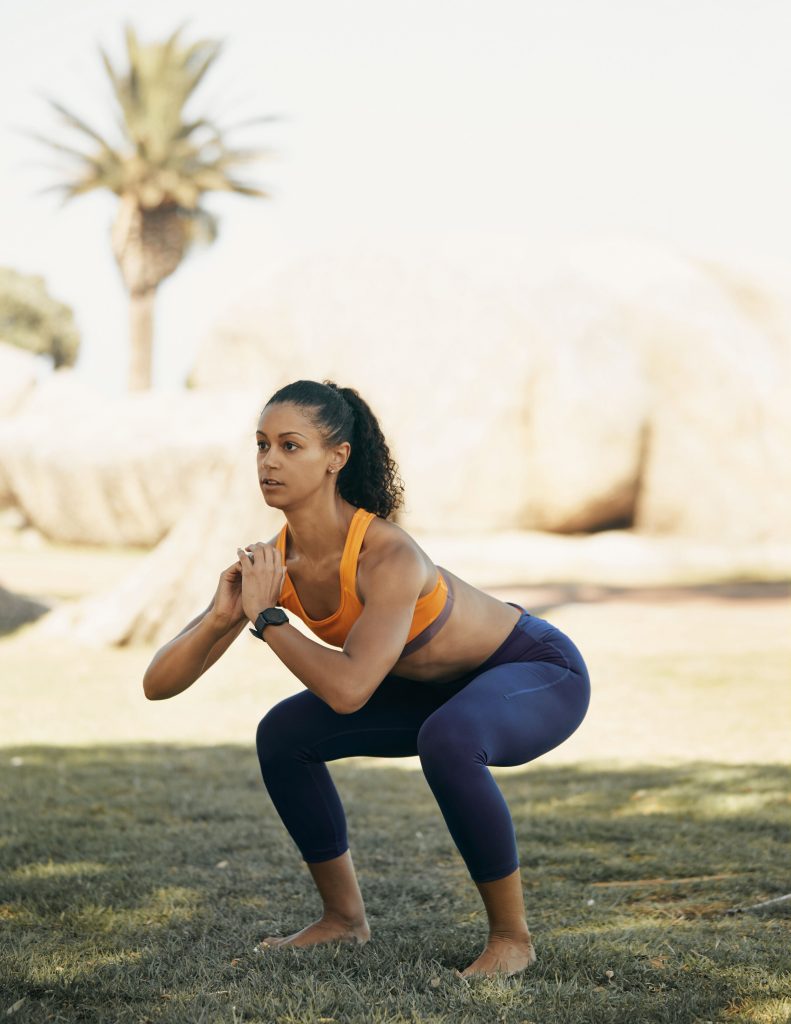
Bodyweight workouts may sound simple, but they aren’t easy. Like training with gym equipment, the benefits of bodyweight workouts thrive when you treat push-ups, squats, lunges, and pulls like trackable strength work and apply progressive overload. As you get stronger, progress doesn’t have to mean endless reps: you can make workouts harder by adding sets and smart volume, shortening rest with supersets/circuits, slowing tempo, adding pauses/isometrics, increasing range of motion, changing leverage, going unilateral, using mechanical drop sets, and training with timed intervals for more challenging workouts.
Key takeaways
- Progressive overload still applies to bodyweight training – progress comes from changing the variation, adding reps/sets, increasing range of motion, or adding load.
- Don’t rely on reps alone forever. Once sets climb into very high reps, switch to smarter progressions like leverage changes, unilateral work, pauses, and tempo.
- Pulling matters for balance. If you’re training with zero equipment, options for back/biceps are limited. Adding a pull-up bar or bands dramatically expands what you can do.
- Use density tools to make workouts more challenging. Circuits, supersets, and timed intervals increase challenge by minimizing rest and increasing work in less time.
- Let Fitbod scale your workouts automatically. Fitbod adapts recommendations based on what you log and your recovery, so as you get stronger, your training stays challenging without constant re-planning.
1) Start with the “progressive overload” mindset
If your body adapts, the workout stops feeling challenging unless you progress to something more measurable. With bodyweight training, progressive overload usually means improving one, or more, of these areas:
- Harder variation (leverage, unilateral, ROM)
- More reps at the same quality
- More sets (weekly volume)
- Less rest (same work in less time)
- Slower tempo / longer tension
- Added load (weighted vest or a backpack)
Fitbod is built around progressive overload. It personalizes training from your inputs and then uses adaptive progression so sets/reps/weights adjust dynamically based on your logged performance.
2) Use Fitbod’s Bodyweight-Only setup the right way
Fitbod’s “Bodyweight-only” training can affect how workouts are generated so equipment accuracy matters. If you want equipment-free sessions, your first priority is to make sure Fitbod’s Available Equipment setting matches your actual set up because Fitbod only includes exercises that match what you’ve selected.
Two practical tips:
- If you have any pulling tool, select it. A pull-up bar, rings, or bands instantly expands balanced training options.
- Log what you actually did. Fitbod learns from your feedback like skipping, replacing, deleting, or manually adding exercises helps it adapt to your preferences.
3) Increase reps but don’t treat reps as the only lever
Reps are the simplest progression:
- Week 1: 3×8 push-ups
- Week 2: 3×10 push-ups
- Week 3: 3×12 push-ups
Higher reps can help build muscle especially when sets are taken close enough to failure with good form. The catch: once you’re routinely pushing sets into very high reps, it can become harder to keep each rep sharp.
Use reps as a phase, then rotate to other levers, like the below. Fitbod’s approach emphasizes variation over time, in other words not doing the same scheme forever, via its dynamic intensity model.
4) Add sets or smart volume
If your variations are capped by limited equipment, adding sets is a straightforward way to keep overload moving:
- Add 1 set to your main movement pattern (push, squat, hinge, pull, core)
- Add back-off sets with an easier variation after a harder one
If a set feels too easy, you can manually adjust it in your Fitbod app which then refines future workouts based on your input.
5) Shorten rest and increase workout density by using supersets or circuits
Pair (superset) or group (circuit) movements back-to-back with minimal rest to make the same work feel harder and finish faster. For example; rest 90s → 75s → 60s and keep sets fixed but reduce your total session time, or add a time cap like “30 quality reps in 8 minutes”. In the Fitbod app, toggle supersets/circuits in Gym Profile settings, and if you use Normalize Weight, the app can match weights across same-equipment exercises. For supersets, move 2 can be normalized to move 1; for circuits, each move can be normalized to the previous move.
6) Slow the tempo
Tempo is one of the most underrated “no equipment” upgrades:
- Push-ups: 3–5 seconds down, controlled up
- Squats: 3 seconds down, brief pause, smooth up
- Split squats: slow descent + control at the bottom
Slowing the eccentric increases time under tension and can make “easy” variations feel heavy without any equipment at all. Use tempo as a phase or finisher tool, not a requirement for every set year-round.
7) Add pauses + isometrics
Pauses shift difficulty to the exact point you need most.
- Push-up: 2–3 second pause just above the floor
- Squat: pause at the bottom
- Lunge: pause at the bottom
- Plank: high-tension plank holds for shorter durations
This is especially useful when you’re managing fatigue but still want high effort.
8) Increase range of motion
More ROM often means more stimulus per rep. Easy upgrades:
- Push-ups on handles/books for a deeper stretch
- Deficit split squats (front foot elevated)
- Pike push-ups with deeper head path
- Hip thrusts from a higher surface
More ROM tends to raise difficulty without turning training into a “circus trick.”
9) Change leverage to make the same move harder
Leverage is the “secret sauce” of strength progression. This is how you keep training “heavy” with just you and gravity.
- Push pattern: Incline push-up → flat push-up → decline push-up → archer/pseudo-planche lean progressions
- Leg pattern: Squat → tempo squat → split squat → front-foot elevated split squat → pistol/shrimp progressions
Core: Dead bug → hollow hold → long-lever plank progressions
10) Go unilateral or one side at a time
Unilateral work multiplies difficulty without extra load:
- Rear-foot elevated split squat (Bulgarian)
- Single-leg RDL
- Step-ups (slow tempo)
- Single-arm push-up progressions
Trainer tip: unilateral training helps expose and correct left/right imbalances.
11) Use mechanical drop sets
Mechanical drop sets = start hard, then make it slightly easier without resting. Examples:
- Decline push-ups → regular push-ups → incline push-ups
- Close-grip push-ups → standard push-ups → knee push-ups
- Front-foot elevated split squat → normal split squat → reverse lunge
Use these 1–2x/week per pattern at most, and keep form strong. Fatigue is the goal, sloppy reps aren’t.
12) Use timed intervals for a different kind of “hard”
Timed intervals turn strength into a work-capacity challenge:
- 40s work / 20s rest × 6 rounds
- Every Minute On the Minute (EMOM): 8–12 quality reps each minute
- As Many Rounds/Reps As Possible (AMRAP) with strict form rules
Timed Intervals and supersets naturally reduce total workout time by minimizing rest between exercises.
13) Add external load, if you can
Weighted exercises are the most direct way to progress once you’re strong, this could be a weighted vest, a backpack with books or light household objects like cans of soup.
User tip: If you add resistance to a bodyweight move in the Fitbod app, use the Added Weight field.
14) Use bands strategically
Bands can make bodyweight training more effective and joint-friendly by letting you:
- Add resistance where bodyweight is easiest, like at the top of push-up
- Assist hard moves so you can train full ROM (pull-ups, pistols)
- Create pulling options when you don’t have machines
If you have resistance bands, add them to your available equipment and Fitbod’s algorithm will use this equipment selection as a core driver of your future programming.
15) Progress your pulling
Push-ups are great for chest/triceps/shoulders. But for biceps or elbow flexion, you’ll progress fastest with chin-ups/rows or bands for curls. If you want balanced upper-body development, prioritize a pulling options with:
- Pull-up bar (chin-ups, pull-ups)
- Rings/TRX (rows)
- Bands (rows, curls)
This is the single best small equipment investment and upgrade for at-home training.
16) Track recovery like an athlete
Making workouts harder only works if you can recover. Fitbod assigns each muscle group a recovery percentage, from 0–100%, based on recently logged workouts, and notes that muscles typically take up to 7 days to fully recover, depending on intensity and individual recovery rates.
So when you crank difficulty with tempo, unilateral work, and drop sets:
- Rotate movement patterns (push/legs/pull/core)
- Respect performance drops
- On iOS, you can also manually adjust recovery if it doesn’t match how you fee
17) Let Fitbod’s adaptive engine do the math
If you want progression without reinventing the wheel, this is where Fitbod shines. Fitbod’s data driven algorithm acts as your AI personal trainer by:
- Personalizing workouts using your goals, experience level, equipment, and workout duration
- Using data-driven adjustments with insights from over millions of workouts
- Applying adaptive progression so sets/reps/weights adjust dynamically based on performance
- Tracking muscle recovery percentages to support progressive overload
A few Fitbod data points worth knowing:
- Fitbod includes over 650 bodyweight exercises and more than 1,600 total exercises with demonstration videos.
- For new exercises, Fitbod’s algorithm weight recommendations are based on data from over 87M logged workouts, and are designed to be conservative.
- Fitbod’s proprietary tech mStrength™ varies intensity and volume across workouts, so you’re not doing the same reps/sets every day.
How to make Fitbod smarter for bodyweight training:
- Log reps honestly and consistently.
- If a recommendation feels too easy, adjust reps/sets, or Added Weight in the app, and Fitbod will refine future workouts based on your input.
- Use supersets, circuits, and timed intervals when you want density-style training.
Keep equipment settings accurate so Fitbod only suggests what you can actually do.
FAQs
- How often should I increase difficulty in bodyweight workouts? Progress when you can hit the top end of your target reps with consistent form. If you adjust reps/sets/Added Weight because something is too easy, Fitbod adapts from those changes and refines your future workouts.
- Are high-rep bodyweight workouts enough to build muscle? They can be, especially when sets are taken close to failure with good form. If reps get very high and time becomes the limiting factor, you can try to progress via leverage, tempo, ROM, unilateral work, density tools, or added load.
- Why does Fitbod sometimes show a “weight” for a bodyweight move? Fitbod notes this can happen if Added Weight was previously logged; setting Added Weight back to 0 can reset future recommendations.
- How can I make a 20–30 minute bodyweight workout feel hard? Use density tools like shorter rest periods, adding supersets/circuits, timed intervals, and mechanical drop sets.
- Can Fitbod track calorie burn for bodyweight workouts? Fitbod can estimate calories for bodyweight workouts based on your workout details and profile data. If you have an Apple Watch, it uses heart rate and includes EPOC.
Final Thoughts
If you’re getting stronger, your bodyweight workouts should evolve from “more reps” into smarter progressions with leverage, tempo, ROM, unilateral work, density, and eventually weighted exercises.
And if you want that progression guided automatically, Fitbod’s system is designed to remove all the guesswork by personalizing workouts from your inputs and then adapting training based on performance, recovery, equipment, and large-scale training insights.


