


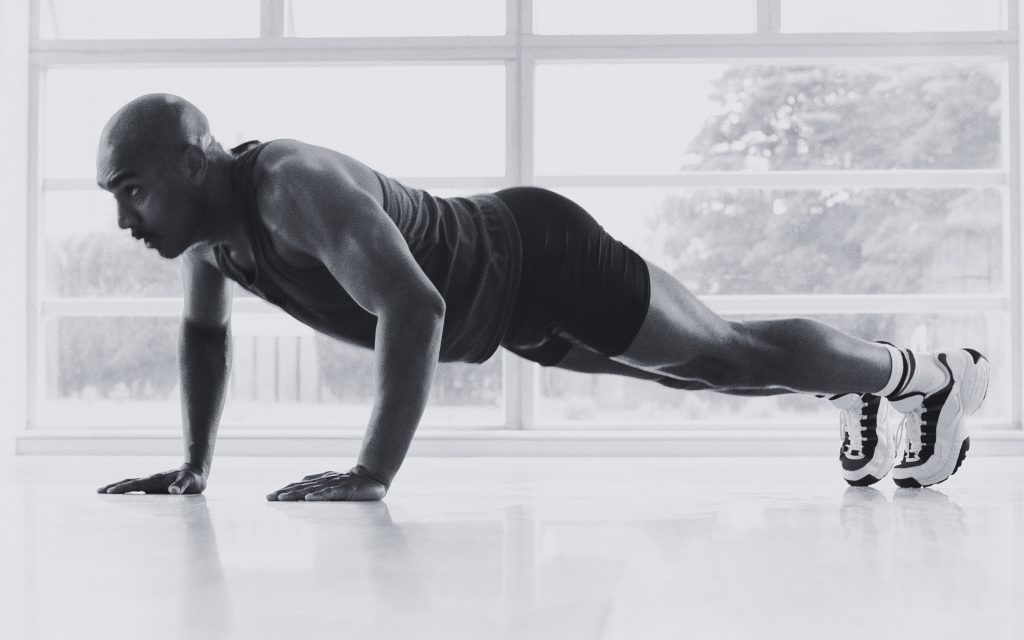
Contrary to popular belief, you don’t need a gym membership, a barbell, or a single piece of equipment to build real, lasting strength. Some of the most effective exercises ever developed require nothing more than your own bodyweight and enough floor space to lie down. That makes strength training not only science backed but highly accessible wherever you are. In this guide, we’re breaking down the 12 best bodyweight exercises for full-body strength: what they are, how to do them correctly, and how to program them so you keep making progress week after week.
Want more data backed fitness tips?
Sign up for our emails today!
TLDR;
- Bodyweight training builds real, functional strength and muscle with no gym or equipment required.
- Compound movements like push-ups, squats, and pull-ups recruit multiple muscle groups simultaneously, maximizing efficiency.
- Progressive overload is possible with bodyweight exercises through tempo, volume, and leverage adjustments.
- Fitbod’s algorithm personalizes bodyweight workouts based on your fitness level, goals, and recovery state.
- Consistency beats complexity: 3-4 sessions per week of the exercises below is enough to build measurable strength.
Table of Contents
- Why Bodyweight Training Works
- Push-Up
- Bodyweight Squat
- Pull-Up
- Dip
- Lunge
- Pike Push-Up
- Glute Bridge
- Inverted Row
- Plank
- Mountain Climber
- Bulgarian Split Squat
- Dead Bug
- How to Program These Exercises
- FAQs
- Final Thought
Why Bodyweight Training Works
There is a persistent myth in fitness that you need a barbell, a rack, or a gym membership to be serious about strength training. Science, as well as millions of practitioners, say otherwise.
Bodyweight training, also called calisthenics, uses your own body mass as resistance. Because many of the most effective movements are compound exercises, they recruit multiple muscle groups at once, driving hormonal responses and neuromuscular adaptations that translate to real-world strength.
Among our vast exercise library, bodyweight movements are among the most frequently logged exercises on the platform, and for good reason. They require zero setup, can be done anywhere, and scale to any fitness level through modifications in tempo, range of motion, leverage, and volume.
Research published in the Journal of Human Kinetics found that an 8-week bodyweight training program significantly improved muscular strength and endurance in adults that hadn’t lifted before. And for intermediate and advanced athletes, progressive calisthenics, where you systematically increase difficulty, can match free-weight training for hypertrophy and strength gains.
The 12 exercises below represent the best of what bodyweight training has to offer. Each targets a major movement pattern: push, pull, hinge, squat, carry, and core – the six pillars of functional strength.
1. Push-Up
Primary muscles: Chest, anterior deltoids, triceps, core
The push-up is the single most versatile upper-body pressing exercise in existence. It trains the same fundamental pattern as the bench press, horizontal pushing, while simultaneously demanding trunk stability that a bench completely removes.
How to do it:
- Start in a high plank with hands slightly wider than shoulder-width.
- Lower your chest to the floor, keeping elbows at roughly a 45-degree angle to your torso.
- Press back to the start, maintaining a rigid body line from head to heel.
Progressions: Incline push-up (easier) → standard push-up → close-grip push-up → archer push-up → one-arm push-up.
Fitbod tip: Fitbod tracks your push-up volume across sessions and adjusts your programming based on muscle recovery scores, so you never repeat a session your chest hasn’t recovered from.
2. Bodyweight Squat
Primary muscles: Quadriceps, glutes, hamstrings, adductors, core
The squat is the king of lower-body development. The bodyweight version is the foundation everyone needs before loading a barbell, and for many people, it’s also a complete training stimulus on its own when programmed with sufficient volume and tempo.
How to do it:
- Stand with feet shoulder-width apart, toes turned out slightly.
- Sit your hips back and down, keeping your chest tall and knees tracking over your toes.
- Descend until thighs are parallel to the floor (or lower, if mobility allows).
- Drive through the full foot to return to standing.
Progressions: Box squat → bodyweight squat → pause squat → Bulgarian split squat → pistol squat.
Fun Fact: A 2021 review in Sports Medicine confirmed that bilateral squatting patterns are among the most effective for developing quadriceps and glute mass and the bodyweight version is a legitimate entry point regardless of training age. Additionally, bodyweight squats help stabilize and even lower glucose levels.
3. Pull-Up
Primary muscles: Latissimus dorsi, biceps, rear deltoids, rhomboids, core
If push-ups are the upper-body pressing standard, pull-ups are the upper-body pulling standard. They are genuinely one of the hardest bodyweight movements to master and one of the most rewarding. A strong pull-up translates to better posture, shoulder health, and grip strength.
How to do it:
- Hang from a bar with a shoulder-width overhand grip.
- Depress and retract your shoulder blades, then drive your elbows toward your hips.
- Chin clears the bar at the top.
- Lower with control; do not drop from the top position.
Progressions: Dead hang → scapular pull-up → band-assisted pull-up → negative pull-up → full pull-up → weighted pull-up.
No bar? Use a sturdy table edge for an inverted row (see exercise 8), which trains the same pulling pattern horizontally.
4. Dip
Primary muscles: Triceps, lower chest, anterior deltoids
Dips are one of the most underrated bodyweight exercises. They load the triceps through a full range of motion and stress the chest in the shortened position, a stimulus that push-ups simply cannot replicate.
How to do it:
- Use parallel bars, two stable chairs, or the edge of a bench.
- Lower until your elbows form a 90-degree angle (or until you feel a stretch across the chest).
- Press back up, locking out the elbows at the top.
- Keep your torso upright for a more triceps-dominant movement, or lean slightly forward to increase chest involvement.
Progressions: Bench dip → parallel bar dip → ring dip → weighted dip.
Caution: If you have a history of shoulder impingement, limit range of motion and ensure your elbows flare no wider than 45 degrees from your torso.
5. Lunge
Primary muscles: Quadriceps, glutes, hamstrings, hip flexors
Lunges train each leg independently, correcting left-right imbalances that bilateral squats can mask. They also demand balance and stability from the hip stabilizers, making them a more complete lower-body exercise than they appear.
How to do it:
- Step one foot forward into a split stance.
- Lower your rear knee toward the floor, keeping your front shin as vertical as possible.
- Drive through the front heel to return to standing.
- Alternate legs for walking lunges, or work one leg at a time for stationary lunges.
Progressions: Reverse lunge → forward lunge → walking lunge → lateral lunge → deficit lunge.
Volume note: Because lunges are unilateral, reps are counted per leg. A set of 10 lunges per leg is equivalent in volume to roughly 20 bilateral reps.
6. Pike Push-Up
Primary muscles: Anterior deltoids, triceps, upper chest
The pike push-up is a shoulder-dominant pressing movement that bridges the gap between a standard push-up and a handstand push-up. It is the most accessible overhead pressing movement available without equipment and directly builds the strength needed for handstand progression.
How to do it:
- Start in a downward dog position hips high, body forming an inverted V.
- Bend your elbows and lower the top of your head toward the floor between your hands.
- Press back up to the start.
Progressions: Pike push-up → elevated pike push-up → wall-supported handstand push-up → freestanding handstand push-up.
7. Glute Bridge
Primary muscles: Glutes, hamstrings, lower back, core
The glute bridge is the go-to hip hinge movement for anyone who cannot yet perform a single-leg hinge pattern. It directly targets the posterior chain, the muscles most commonly underdeveloped in sedentary populations, and is a low-impact way to build the glutes without spinal loading.
How to do it:
- Lie on your back with knees bent and feet flat on the floor, hip-width apart.
- Drive through your heels to lift your hips off the floor until your body forms a straight line from shoulders to knees.
- Squeeze your glutes at the top, hold for one second, then lower with control.
Progressions: Glute bridge → single-leg glute bridge → elevated glute bridge → hip thrust (with a bench).
Fitbod data point: Hip hinge patterns including glute bridges and their progressions are consistently among the most frequently recommended movements for users whose muscle recovery data shows they need posterior chain work with minimal spinal load.
8. Inverted Row
Primary muscles: Rhomboids, latissimus dorsi, biceps, rear deltoids, core
The inverted row (also called a bodyweight row) is the horizontal pulling counterpart to the push-up. It directly addresses the postural imbalance that develops from excessive pushing, a common issue for people who train push-ups frequently but neglect their back.
How to do it:
- Set up a bar, table edge, or gymnastics rings at hip height.
- Lie underneath it and grip overhand, arms fully extended.
- Pull your chest up to the bar, squeezing your shoulder blades together at the top.
- Lower with control.
Progressions: Bent-knee inverted row → straight-leg inverted row → feet-elevated inverted row → rings inverted row.
9. Plank
Primary muscles: Transverse abdominis, rectus abdominis, obliques, glutes, shoulders
The plank is not a glamorous exercise, but it is one of the most honest assessments of full-body tension. It teaches the core to resist extension the most functionally important job of the abdominals and has direct carryover to every other exercise on this list.
How to do it:
- Place forearms on the floor, elbows under shoulders.
- Maintain a rigid body line from head to heel no sagging hips, no raised glutes.
- Breathe steadily. Hold the position.
Progressions: Plank → plank shoulder tap → RKC plank → plank with reach → plank to push-up.
Duration vs. reps: Research from the Journal of Strength and Conditioning Research suggests that for core stability training, shorter holds with higher tension (the RKC plank, where you actively squeeze every muscle) are more effective than extended passive holds.
10. Mountain Climber
Primary muscles: Core, hip flexors, shoulders, cardiovascular system
Mountain climbers combine the demands of a plank with dynamic hip flexion, turning a static hold into a metabolic conditioning drill. They are one of the best exercises for simultaneously training core stability and elevating heart rate.
How to do it:
- Start in a high plank position.
- Drive one knee toward your chest, then quickly switch legs in an alternating pattern.
- Keep hips level, do not let them pike up or sag.
- Speed determines intensity: slow and deliberate trains stability; fast trains conditioning.
Programming note: Mountain climbers work equally well as a strength accessory (slow, deliberate tempo, 10 reps per side) or a conditioning tool (30-second sprint efforts with short rest).
11. Bodyweight Bulgarian Split Squat
Primary muscles: Quadriceps, glutes, hamstrings, hip flexors
The Bodyweight Bulgarian split squat is the most effective single-leg lower-body exercise in this list and arguably in all of strength training. Research consistently shows it produces similar quad and glute activation to the back squat at much lower spinal loads. It also exposes and corrects mobility restrictions at the hip flexor and ankle.
How to do it:
- Elevate your rear foot on a bench or chair at about knee height.
- Position your front foot far enough forward that your shin stays vertical at the bottom.
- Lower your rear knee toward the floor, keeping your torso upright.
- Drive through the front heel to return to standing.
Why it’s hard: This movement demands hip flexor flexibility, quad strength, and single-leg balance simultaneously. Expect it to humble you the first time.
Progressions: Bulgarian split squat → tempo Bulgarian split squat → deficit Bulgarian split squat → loaded variation.
12. Dead Bug
Primary muscles: Transverse abdominis, rectus abdominis, obliques, hip flexors
The dead bug is one of the most effective core exercises in Fitbod’s library and one of the most underrated. Unlike crunches, which train the core through spinal flexion, the dead bug trains anti-extension: the ability to resist your lower back arching away from neutral under load. That skill directly transfers to every other exercise in this list.
How to do it:
- Lie on your back with arms extended straight toward the ceiling and knees bent at 90 degrees, shins parallel to the floor.
- Press your lower back firmly into the floor and hold it there throughout the entire movement.
- Slowly lower your right arm overhead and extend your left leg toward the floor simultaneously.
- Stop just before your lower back lifts, then return to start and repeat on the opposite side.
The rule: If your lower back breaks contact with the floor, you’ve gone too far. Range of motion is earned, not assumed.
Progressions: Bent-knee dead bug → straight-leg dead bug → dead bug with resistance band → dead bug with dumbbell reach.
How to Program These Exercises
A well-structured bodyweight program hits each major movement pattern 2–3 times per week with adequate recovery between sessions. Here is a simple three-day full-body template using the exercises above:
| Day | Push | Pull | Squat/Hinge | Core |
| A | Push-Up 3×10 | Pull-Up 3×max | Bodyweight Squat 3×15 | Plank 3×30s |
| B | Pike Push-Up 3×8 | Inverted Row 3×12 | Bulgarian Split Squat 3×8/leg | Dead Bug 3×20s |
| C | Dip 3×10 | Pull-Up 3×max | Glute Bridge 3×15 | Mountain Climber 3×20/side |
Progressive overload without weights: Increase reps each session until you hit the top of a rep range (e.g., 15 push-ups), then add a harder variation or increase time under tension with a 3-second lowering tempo.
The Fitbod app automates this process. Our algorithm tracks your performance and muscle freshness score across sessions and automatically selects the right variation, volume, and intensity for each future workout; including bodyweight-only programs for users who select “no equipment” as their gym setting.
FAQs
- Can you build significant muscle with only bodyweight exercises? Yes. Muscle growth (hypertrophy) requires mechanical tension, metabolic stress, and muscle damage – all of which bodyweight exercises can provide. Research shows that bodyweight training produces comparable hypertrophy to resistance training when volume and intensity are matched. The key is progressive overload: systematically increasing difficulty over time.
- How many days per week should I do bodyweight training? Three to four days per week is the sweet spot for most people. This allows enough frequency to drive adaptation while providing sufficient recovery. Full-body sessions three days per week (like in the template above) work well for beginner and intermediate lifters.
- What if I can’t do a pull-up yet? Start with negative pull-ups (jump to the top position and lower slowly) and inverted rows. Both build the pulling strength needed for a full pull-up. Fitbod will automatically recommend the appropriate regression based on your logged fitness level.
- Is bodyweight training good for weight loss? Bodyweight training builds muscle, which increases resting metabolic rate over time. Combined with a caloric deficit, it is an effective tool for fat loss. High-rep circuits and movements like mountain climbers also provide an effective cardiovascular component.
- Do I need any equipment at all? Most exercises on this list require no equipment. A pull-up bar (available for under $30) unlocks the pulling movements and is the single most impactful piece of equipment you can add to a home training setup.
- How does Fitbod help with bodyweight training? Fitbod lets you set your equipment to “body weight only” and will generate personalized workouts using the movements you can do. It tracks your volume, adjusts for muscle recovery, and progressively challenges you over time the same way it would with a full gym and personal trainer setup.
- How long before I see results from bodyweight training? Most people notice strength improvements within 2-4 weeks and visible muscle changes within 6-12 weeks, depending on training consistency, nutrition, and sleep. Neurological adaptations (getting better at the movement pattern itself) happen quickly; structural adaptations (muscle tissue growth) take longer.
Final Thought
You do not need a gym to build a strong, capable body. The 12 exercises in this list cover every major movement pattern: pushing, pulling, squatting, hinging, and core stability and they scale from absolute beginner to advanced athlete through progressive variation alone. The limiting factor has never been equipment. It has always been consistency and intelligent programming.
That is where Fitbod earns its place in your training. Rather than leaving you to guess at progressions or piece together random workouts from the internet, Fitbod’s algorithm learns your body, tracks your recovery score, and builds you a program that evolves as you do whether you’re working out in a fully-equipped gym or in your living room. Start with the basics. Progress methodically. And trust that the simplest movements, done consistently over time, produce results that the more complicated programs never will.


