
How to do a Loop Band Pulse Lunge
Reviewed by Jim Parker, CPT, B.A. Kinesiology
About this exercise
- Sets Logged
- 13,755
- Popularity Rank
- 1018th
- Difficulty
- Beginner
- Quads Strength
- 91 mSCORE 33rd
- Equipment Required

Workouts with Loop Band Pulse Lunge
Target muscles worked
Instructions for Proper Form
Loop Band Pulse Lunge is a variation on the more standard Lunge. Similar to other Lunge variations, this compound exercise primarily targets the quadriceps. Unlike other variations, this exercise doesn’t progress you through a full lunge, but instead has you pulse up and down from a shallow to a deep lunge. This keeps more tension in your legs throughout the exercise without allowing you to rest as you return to the starting position. The use of a loop band allows you to add resistance to the movement, especially at the top.
- Stand with feet shoulder-width apart and step forward with one leg keeping your torso upright.
- Place the band under the midfoot area of the front foot and pull the loop up over your head so it rests across the back of your shoulders.
- Keep your hands on the hips (or on the band) and bend your knees to lower the body towards the ground until both knees reach 90 degree angles.
- Slowly raise your body upward by extending your legs and repeat the movement.
- Switch side once one side is complete.
Common Form Mistakes
Varying Tension with Bands
Resistance increases as you stretch a band. Make sure you’re using a band that allows you to move through your full range of motion. The resistance may feel too light during parts of the movement.
Improper Distance
The exact distance for an ideal lunge varies for everyone, but it’s incredibly important. A small step can lead to more tension on your knee, as well as a narrow base of support. A long step can also lead to instability. Both will increase your risk of injury, and make the exercise less effective. If you’re struggling with lunge distance, start with a position where you feel stable, and experiment with small adjustments until you find the distance you’re comfortable with.
Alternatives & Variations to Loop Band Pulse Lunge
1. Barbell Hip Thrust
 95.2 mSCORESWAPPED 32 TIMES
Barbell Hip Thrust is a more challenging, weighted variation of the Hip Thrust. Beyond the added resistance from using a barbell, you’ll also place your shoulder blades on a flat bend in or to raise yourself off the ground. This is a great variation for anyone looking to make their Hip Thrusts more challenging.
2. Loop Band Sumo Deadlift
 48.3 mSCORESWAPPED 17 TIMES
Incorporating the wide stance of the sumo deadlift, this variation uses a loop band to provide resistance, targeting the glutes, hamstrings, and inner thighs. It's an effective lower body exercise that also engages the lower back and core, improving posture, strength, and flexibility. The loop band allows for a controlled lift, reducing strain on the spine compared to traditional weights.
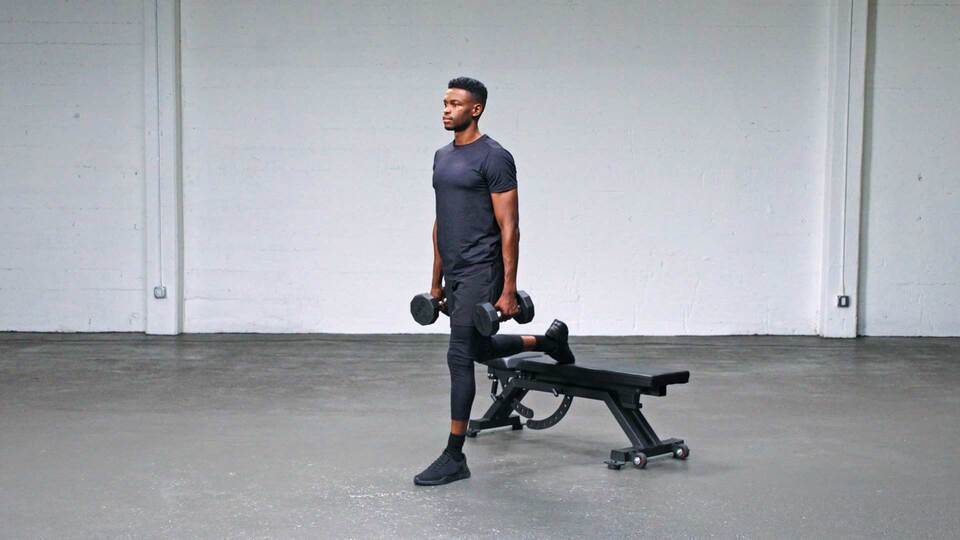
3. Dumbbell Bulgarian Split Squat
 91.4 mSCORESWAPPED 16 TIMES
Dumbbell Bulgarian Split Squat is a weighted variation of a Bulgarian Split Squat. Like other Bulgarian Split Squats, this exercise is a compound movement that primarily targets your quads. The use of dumbbells allows you to add more resistance to this exercise, without restricting your range of motion and posture as much as using a barbell.
4. Pulse Lunge
 35.5 mSCORESWAPPED 15 TIMES
Pulse Lunge is a compound exercise that primarily targets the quads. Unlike standard lunges, this variation involves pulsing up and down from a shallow to deep lunge without returning to a standing position. This keeps tension on your muscles throughout the entire set, making it a great way to enhance muscle endurance and strength.
- Intermediate
- Quads
5. Lunge
 90.8 mSCORESWAPPED 15 TIMES
Lunges are one of the most common lower body exercises out there. It’s a compound exercise that primarily targets your quads. In order to return to a standing position with this exercise you need to engage your quads in order to push yourself back up. This further emphasizes your quadriceps compared to other Lunge variations, however this also places more tension on your knee. By stepping forward with a single leg taking most of the load, you can more easily identify, and address any discrepancies in mobility or strength between sides.
6. Air Squats
 92.1 mSCORESWAPPED 12 TIMES
Air Squats are a bodyweight variation of Squats. Like other variations, this is a compound exercise that primarily targets the quadriceps. Without any added resistance this is easily one of the most beginner friendly exercises out there. It’s a great way to start building strength, and working your way towards more advanced variations.
7. Handle Band Squat
 54.4 mSCORESWAPPED 9 TIMES
Incorporating a handle band into squats adds resistance to the standard squat movement, targeting the quads, glutes, and hamstrings. This variation increases lower body strength and stability, offering a versatile and effective workout accessible anywhere.
8. Loop Band Back Squat
 69.7 mSCORESWAPPED 8 TIMES
Loop Band Back Squat is a variation of squats. Like other squats, this compound movement primarily targets the quadriceps. The use of a loop band allows for more resistance than simply body weight, especially at the top of the movement. As you descend into the squat, the tension on the loop band will decrease making this a great variation for anyone with limited mobility in a deep squat position.
9. Side Lunge
 79.4 mSCORESWAPPED 8 TIMES
Side Lunge is a variation on the more standard Lunge. Similar to other Lunge variations, this compound exercise primarily targets your quadriceps. By stepping to the side instead of forward or backwards, you can further recruit smaller muscles around your hips like your Adductors (the muscle that brings your legs together).
10. Mini Loop Band Hip Flexor
 34 mSCORESWAPPED 7 TIMES
Targeting primarily the hip flexors, this exercise is beneficial for improving hip mobility and strength. The mini loop band adds resistance, making it more challenging than traditional hip flexor exercises. It's essential for athletes and individuals seeking to enhance lower body performance and reduce the risk of injuries.