Best Legs Workouts With Cable Machines
About
Cable machines offer a versatile method to enhance lower body strength effectively. They allow for adjustable resistance directions and interchangeable handles, enabling precise muscle group targeting. The major muscles in the legs include glutes, quadriceps, hamstrings, calves, adductors, and abductors, often engaged together in compound exercises. Common selections like squats, deadlifts, and lunges effectively stimulate these groups. Adjusting repetitions and weights considering individual capacity and goals is essential for balanced muscle development. Integrating cable machines into your routine can refine your lower body workout strategy.
If you have access to a cable machine, you may wonder what exercises you can do to target your legs.
As a strength coach, I can teach you which leg exercises with cables are worth performing and which are a waste of time.
I’ll explain each exercise to help you perform them correctly and provide a sample leg day you can start implementing today.
Anatomy Of Leg Muscles
The main muscle groups of the legs that you should focus on when building leg muscle are the hamstrings, quadriceps, glutes, and calves.
Hamstrings
The hamstrings run along the backside of the legs, above the knee, and below the hips. They are responsible for bending the knee (flexion) and straightening (extending) the hips.
Training the hamstrings is usually done by adding a movement that requires hip extension, like a Romanian deadlift or good morning, and another exercise that works the hamstring at the knee joint, like a leg curl.
Quadriceps
The quads run along the front of the thighs and straighten (extending) the knees after they bend.
Targeting the quads is usually done by including movements that have the knees bend to their fullest amount, such as deep squats, lunges, step-ups, and even leg extensions.
Glutes
The glutes cover the back of the hips. These powerful muscles (gluteus medius, minimus, and maximus) extend the hips and stabilize the pelvis during most movements.
Training these muscles can be done by lifting the legs outwards away from the body (train the gluteus minimus), as well as bending and extending the hips (trains the gluteus maximus and medius), such as during Romanian deadlifts, good mornings, lunges, deep squats, step-ups, and hip thrusts.
Calves
The calves are the muscles on the back of the lower leg, below the knee. They are responsible for the ankle joint's plantar flexing (pointing the toes down) and are active in most movements (walking, running, jumping, and lifting).
You can train the calves using standing or seated calf raise exercises.
Benefits Of Cable Leg Exercises
Below are three benefits of performing leg exercises with cables.
Offers Variety Within Your Training
If you struggle to stay motivated and find doing the same old workouts boring (and, therefore, you skip workouts), you can add a cable exercise here and there to spice up your training sessions.
That said, sacrificing a more effective movement for something “new or fun” is not the best idea for muscle or strength improvements; For example, trading barbell back squats for cable squats.
However, if it’s a decision between skipping the workout entirely (i.e., movement restrictions, injuries, etc.) or doing some new exercise, choose the new movements.
Ideally, you should do 80% of your leg training using free weights and machines, with compound exercises like squats, Romanian deadlifts, and lunge variations. The other 20% of your training time can include cables or isolation machines.
May Help Establish Better Movement Coordination
Cables help lifters execute proper movement patterns when lifting by providing constant tension. This guidance can establish better movement coordination and confidence with specific exercises.
For example, a cable RDL may be helpful for lifters who struggle to do normal RDLs, as the cables pull the weight downwards and provide a visual representation of the weight's path.
Beginners who struggle to grasp proper movement patterns would benefit from cable variations of compound movements (e.g., squat and deadlift) and exercises that require balance and coordination (e.g., single-leg exercises). There is more room for error when training with free weights.
Progress Loads If You Don’t Have Access to Free Weights or Leg Machines
Suppose you find yourself in a situation where you ONLY have access to a cable machine. In that case, the cables will at least offer you the ability to add external load to lower body movements.
Constant Tension on the Muscle
Assuming you control the cable during the lower phases and do not rely on momentum, you can take advantage of one of the biggest benefits of cables.
Cables allow you to keep constant tension on the muscles, which means you will not allow the muscle fibers to relax or take a break during the movement. This ramps up the time under tension, a potent muscle builder.
Are Cables Better Than Free Weights and Machines for Leg Exercises?
Cables are by no means better than machines or free weights, so I don’t recommend that you replace your machine and free-weight exercises with cable exercises.
The only situations where cables might be more beneficial than free weights and machines are when you’re struggling to isolate a particular muscle group or unable to perform the movement pattern with free weights.
However, when it comes to getting stronger and building muscle, cables are no match for free weight and machine exercises.
Researchers found that instability exercises had lower force outputs than more stable variations, which may harm absolute strength gains when resistance training. Machines and free weights allow you to set yourself in a more stable position, producing more force through the muscle (because your setup, odd angles, or movement instability do not limit you).
Frequently Asked Questions
Are Cables Good For Leg Training?
No, they are not the best tool for leg training. Barbells, dumbbells, and leg machines are far more efficient and effective. Cables can be challenging to set up, hard to load with heavier loads, and can limit the overall intensity at which you can push a muscle. That said, they are better than doing no leg exercise.
Can You Build Bigger Legs Using Only Cables?
If your only option is to use cables for your legs and you are a beginner who has never trained them, then yes. However, growing bigger legs using cables will be challenging if you are a stronger, more advanced lifter.
Workout 1
Glutes, Quadriceps, Hamstrings, Abductors, Adductors
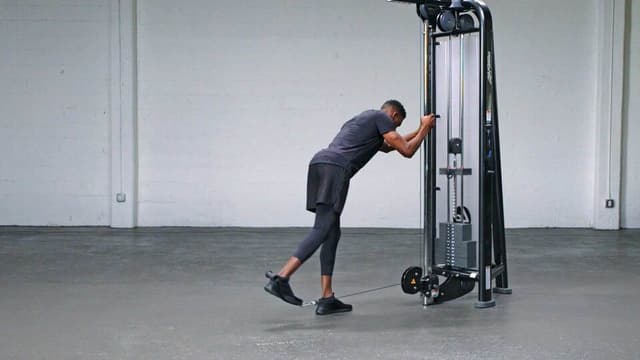
Cable Hip Extension
- 15reps40lbs
- 25reps40lbs
- 35reps40lbs
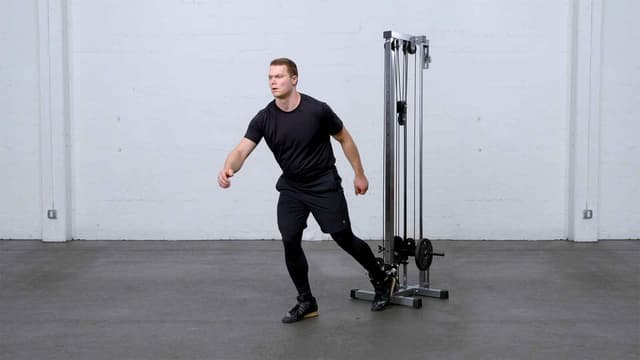
Cable Knee Drive
- 110reps15lbs
- 210reps15lbs
- 310reps15lbs

Cable Row with Squat
- 18reps35lbs
- 28reps35lbs
- 38reps35lbs

Cable Hip Abduction
- 110reps25lbs
- 210reps25lbs
- 310reps25lbs

Cable Hip Adduction
- 110reps22.5lbs
- 210reps22.5lbs

Cable Pull Through
- 110reps35lbs
- 210reps35lbs
The 6 Best Legs Exercises with Cable Machines
Ranked By
Ranked based on Fitbod's internal data set of the most effective exercises. Learn More
1. Cable Hip Extension
Cable Hip Extension demonstration video — proper form for this exercise. SETS LOGGED1,064,458Glutes Strength95 mScoreGlutes Hi-Lo Pulley Cable
Cable Hip Extension is an exercise where you attach your leg to a cable machine and extend it behind you while standing. This helps strengthen your glutes and improve balance, as the cable provides controlled resistance.
How to do it
- Set the pulley to the lowest position and attach the ankle cuff to your right ankle.
- Stand facing the pulley with your feet hip-width apart, holding the frame for support.
- Engage your core and keep your back straight.
- With a slight bend in your knee, extend your right leg behind you by squeezing your glute.
- Return to the starting position and switch to your left leg.
Sets, Reps, Weight18reps30lbs28reps30lbs38reps30lbs2. Cable Pull Through
Cable Pull Through demonstration video — proper form for this exercise. SETS LOGGED961,630Glutes Strength91 mScoreGlutesHi-Lo Pulley CableThe Cable Pull Through is an effective exercise that strengthens your glutes and improves your hip hinge movement. It uses a cable for steady resistance, making it easier to build muscle and enhance glute power. This is a good choice for beginners wanting to develop their lower body strength.
How to do it
- Set the pulley to the lowest position with a rope attachment.
- Stand with your back to the pulley, hold the rope with palms facing in, and keep your arms resting on your hips.
- Step forward 1-2 feet from the pulley with feet wider than shoulder-width apart.
- Engage your core, keep your back straight, and hinge your hips back while keeping your knees slightly bent.
- Hinge until your back can no longer stay straight, then return to the starting position.
Sets, Reps, Weight18reps35lbs28reps35lbs38reps35lbs3. Cable Row with Squat
Cable Row with Squat demonstration video — proper form for this exercise. SETS LOGGED240,207Hamstrings Strength89 mScoreHamstringsHi-Lo Pulley CableThe Cable Row with Squat is an exercise that combines a squat with a cable row. It works your legs and upper body, helping build strength in both areas while maintaining a squat position.
How to do it
- Stand with feet shoulder-width apart and adjust the cable to belly button height.
- Grab the handles with palms facing in, elbows bent and at your sides.
- Lower into a squat while pulling the handles towards the cable anchor.
- Stand up and row the handles back to your torso, keeping your back straight.
Sets, Reps, Weight18reps50lbs28reps50lbs38reps50lbs4. Cable Knee Drive
Cable Knee Drive demonstration video — proper form for this exercise. SETS LOGGED14,254Quadriceps Strength59 mScoreQuadricepsHi-Lo Pulley CableThe Cable Knee Drive is an exercise that strengthens your hip flexors and core while improving your lower body power and stability. Using a cable attached to your ankle, you drive your knee upward, simulating running and jumping motions, which helps with athletic performance.
How to do it
- Adjust the cable machine to the lowest setting.
- Attach the cable to one ankle.
- Step back to create tension in the cable.
- Face away from the machine and get into a light lunge position, securing your back foot.
- Keep your core tight, back straight, and look forward for good posture.
- Ensure the cable is aligned with your anchored ankle.
- Engage your core and align your pelvis with your spine.
- Drive your knee up and forward while keeping your toes pointed up.
- Press your opposite heel into the ground as you move your knee.
- Swing your same-side arm backward like in running.
- Slowly lower your foot to the ground, keeping tension in the cable.
- Finish the set, switch legs, and repeat.
5. Cable Hip Abduction
Cable Hip Abduction demonstration video — proper form for this exercise. SETS LOGGED210,050Abductors Strength53 mScoreAbductorsHi-Lo Pulley CableCable Hip Abduction is an exercise that works your glutes and hip muscles. Using a cable machine helps keep the muscles engaged throughout the movement, improving strength and balance.
How to do it
- Set the cable to its lowest setting and attach the ankle strap to your inner ankle.
- Stand sideways to the cable with your feet together.
- Lift your leg sideways away from your body, keeping it straight. Use something sturdy for balance if needed.
- Slowly return your leg to the starting position and repeat.
Sets, Reps, Weight18reps25lbs28reps25lbs38reps25lbs6. Cable Hip Adduction
Cable Hip Adduction demonstration video — proper form for this exercise. SETS LOGGED145,994Adductors Strength83 mScoreAdductorsHi-Lo Pulley CableCable Hip Adduction uses a cable machine to strengthen your hips and lower body. It allows for controlled resistance as you move your leg across your body, enhancing hip stability.
How to do it
- Set the cable machine to its lowest setting.
- Attach the ankle strap to your outer ankle.
- Stand sideways to the cable with feet together.
- Lift your leg across your body in front of your other leg while holding onto something for balance.
- Lower your leg back to start and repeat.
Sets, Reps, Weight18reps25lbs28reps25lbs38reps25lbs
Alternative Workouts
Alternative Workouts with Cable Machines
- Best Workouts With Cable Machines To Get Lean And Burn Fat
- Best Upper Body Workouts With Cable Machines
- Best Arms Workouts With Cable Machines
- Best Full Body Workouts With Cable Machines
- Best Pull Day Workouts With Cable Machines
- Best Push Day Workouts With Cable Machines
- Best Biceps Workouts With Cable Machines
- Best Triceps Workouts With Cable Machines
- Best Bicep And Shoulders Workouts With Cable Machines
- Best Abs Workouts With Cable Machines
- Best Chest And Back Workouts With Cable Machines
- Best Chest And Tricep Workouts With Cable Machines
- Best Beginner Workouts With Cable Machines
- Best Advanced Workouts With Cable Machines
- Best Workouts With Cable Machines To Build Muscle Mass
- Best Workouts With Cable Machines To Build Strength
- Best Workouts With Cable Machines For Women
- Best Workouts With Cable Machines For Men
- Best Core Workouts With Cable Machines
- Best Back Workouts With Cable Machines
- Best Chest Workouts With Cable Machines
- Best Shoulders Workouts With Cable Machines
Alternative Legs Workouts
- Best Legs Workouts With Landmine
- Best Legs Workouts With Dumbbells
- Best Legs Workouts With Barbells
- Best Legs Workouts With Weight Machines
- Best Legs Workouts With Pvc Pipe
- Best Legs Workouts With Smith Machine
- Best Legs Workouts With Kettlebells
- Best Legs Workouts With Flat Bench
- Best Legs Workouts With Garage Gym
- Best Legs Workouts With Medicine Balls
- Best Legs Workouts With Bosu Balance Trainer
- Best Legs Workouts With Resistance Bands
- Best Advanced Legs Workouts
- Best Beginner Legs Workouts
- Best Legs Workouts With Trx
- Best Legs Workouts For Men
- Best Legs Workouts To Build Strength
- Best Legs Workouts For Women
- Best Legs Workouts To Olympic Lift
- Best Legs Workouts With Stability Swiss Ball
- Best Legs Workouts With Bodyweight
- Best Legs Workouts To Power Lift
- Best Legs Workouts To Get Lean And Burn Fat
- Best Legs Workouts To Build Muscle Mass
Alternative Legs Workouts with Cable Machines
- Best Legs Workouts With Cable Machines To Get Lean And Burn Fat
- Best Advanced Legs Workouts With Cable Machines
- Best Legs Workouts With Cable Machines To Build Strength
- Best Legs Workouts With Cable Machines For Men
- Best Legs Workouts With Cable Machines To Build Muscle Mass
- Best Legs Workouts With Cable Machines For Women