Best Shoulders Workouts With Cable Machines
About
Cable machines offer versatility in strength training by enabling the adjustment of resistance direction and incorporating varied handles for customized exercises.
This adaptability is particularly beneficial for targeting specific muscle groups, including the deltoids.
The deltoids, a muscle group crucial for shoulder movement and stability, play an integral role in upper body exercises.
Common exercises to engage this group involve controlled overhead presses and precise straight arm raises, both achievable on cable machines.
By utilizing this equipment effectively, individuals can refine their workout routines to emphasize shoulder development.
If you struggle to grow your shoulders or lack muscle definition, consider adding more cable shoulder exercises to your workouts. Cables allow you to target all areas of the shoulders with constant loading and are highly effective at helping you find the best angles to get the best shoulder workouts.
Anatomy Of Shoulder Muscles
The shoulders are composed of a few muscle groups that all contribute to the shape and size of the shoulders. The following muscle groups can further be broken down into smaller muscles, each performing essential roles to support shape, size, and function.
Anatomy Of Shoulder Muscles
The shoulders are composed of a few muscle groups that all contribute to the shape and size of the shoulders. The following muscle groups can further be broken down into smaller muscles, each performing essential roles to support shape, size, and function.
Deltoids
The deltoid is a large muscle that covers the entire shoulder region. This muscle has three main groupings of muscle fibers (anterior, lateral, posterior) that each contributes to the overall shape and size of the shoulders.
The anterior deltoid muscle fibers are trained during most pressing exercises (both overhead and horizontally, like the bench press). These can also be isolated with front raises and front presses.
The lateral deltoid muscle fibers are also trained during overhead pressing movements, lateral raises, or any other movement that has you lift the arms out to the sides (with straight elbows).
Lastly, the posterior deltoid muscle fibers cover the back of the shoulders and are trained during pulling movements like face pulls and high rows. These also can be isolated with rear flys.
Rotator Cuff Muscles
The rotator cuff muscle group is made up of many smaller muscles that help to support the shoulder joint. While these muscles are crucial to shoulder development (more from an injury prevention standpoint), you typically do not need to train them directly (other than in warm-ups) as they are used during all shoulder exercises to stabilize the joint.
However, if you are unstable in these movements, are currently dealing with an injury, or have had a previous shoulder injury, you may want to consult with a doctor or physical therapist to see if you need to do more rehabilitation exercises to prepare for shoulder workouts.
Trapezius
The trapezius is a large muscle that spans from the upper back down the spine. While the traps are not part of the shoulders per se, they play a vital role in stabilizing the scapular (shoulder blades), which can help promote shoulder health and strength.
The trap, primarily the upper traps, also provides some additional shape and size to the upper back and shoulders, so shrugs, face pulls, and upright rows are often included in “shoulder” workouts.
3 Unique Benefits Of Cable Shoulder Exercises
While there are many benefits (such as; the ability to train one arm at a time, the versatility of training many exercises with one piece of equipment, etc.), the 3 benefits below are unique to cables (and cannot be said for dumbbells, barbells, or machines).
Smooth, Constant, and Consistent Loading
Cables allow you to keep constant tension and loading on the shoulders throughout the entire range of motion. This is key for exercises like front, lateral, and rear raises.
When using free weights, you always work against gravity, which works vertically (gravity pulls loads and objects straight down), which means that when you lift weights farther from your body, they will be more challenging (due to leverage and physics).
This is why it's harder to raise your arms to your shoulder height when doing lateral raises than it is just to raise them to your stomach height.
With free weights, there will also be a portion of the movement where you get to relax and take tension off of your shoulder muscles.
Training with cables takes all that away, allowing you to train your shoulder muscles throughout the entire range of motion.
Can Train A Variety of Angles
Cables are great for quickly changing the angles at which you are performing an exercise while keeping the same amount of tension and loading on the muscle. You can quickly slide the pulley up or down, or sometimes even broader or narrower to fit the individual needs of the lifter.
By training various angles, you can hit all heads of the shoulders (front, lateral, and rear) easily and quickly (often without changing your torso position).
Ideal for Isolation Exercises
There is no denying that free weights are great for building more prominent, more muscular shoulders (especially dumbbell and barbell shoulder presses). Cables, however, offer you the ability to isolate those muscles more directly (even more than free weights) due to the benefits listed above.
This means that adding more cables could be a good option if you are looking just to isolate the shoulder.
To get the best of both worlds, I recommend choosing 2-3 free weight movements (for general strength & hypertrophy) and 2-3 cable exercises (for specific isolation) for each shoulder workout.
Frequently Asked Questions
How Do You Train Shoulders With Cables?
Training shoulders with cables is very similar to training without cables; the main difference is that you will need to adjust the pulley height and sometimes change the angle you are at (you may be standing, bent over, leaning, or lying) to best target the shoulder muscles.
Are Cables Good For Shoulders?
Cables are a great way to train the shoulders as they allow you to train all shoulder muscles with smooth, constant tension. Unlike free weights, cables can be adjusted to meet the lifter's needs while attacking various angles (not just vertically against gravity) to isolate the shoulders better.
Workout 1
Shoulders
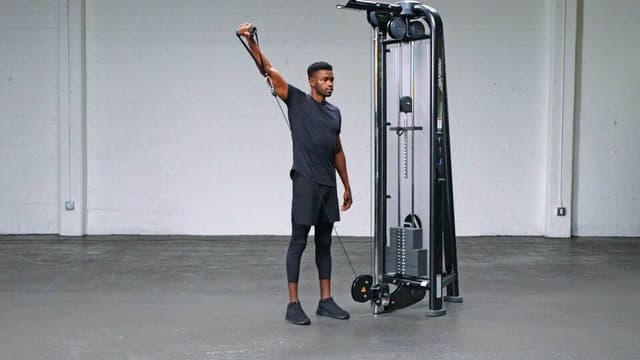
Cable Lateral Raise
- 15reps15lbs
- 25reps15lbs
- 35reps15lbs

Cable Face Pull
- 110reps35lbs
- 210reps35lbs
- 310reps35lbs

Cable Rear Delt Fly
- 18reps22.5lbs
- 28reps22.5lbs
- 38reps22.5lbs

Cable Shoulder Press
- 110reps35lbs
- 210reps35lbs
- 310reps35lbs

Freemotion Shoulder Press
- 110reps45lbs
- 210reps45lbs

Behind the Back Cable Lateral Raise
- 110reps30lbs
- 210reps30lbs
Workout 2
Shoulders

Cable Front Raise
- 15reps15lbs
- 25reps15lbs
- 35reps15lbs

Cable Shoulder External Rotation
- 110reps17.5lbs
- 210reps17.5lbs
- 310reps17.5lbs

Cable Shoulder External Rotation at 90°
- 18reps25lbs
- 28reps25lbs
- 38reps25lbs

Cable Shoulder Internal Rotation at 90°
- 110reps25lbs
- 210reps25lbs
- 310reps25lbs

Cable Shoulder Internal Rotation
- 110reps7.5lbs
- 210reps7.5lbs

Dumbbell Hanging Lateral Raise
- 110reps30lbs
- 210reps30lbs
The 12 Best Shoulders Exercises with Cable Machines
Ranked By
Ranked based on Fitbod's internal data set of the most effective exercises. Learn More
1. Cable Lateral Raise
Cable Lateral Raise demonstration video — proper form for this exercise. SETS LOGGED1,978,112Shoulders Strength97 mScoreShoulders Hi-Lo Pulley Cable
The Cable Lateral Raise is a shoulder exercise that targets the middle deltoid muscle. Using a cable machine allows for better control and can help identify strength differences between your left and right sides.
How to do it
- Adjust the pulley to the lowest position and attach a handle.
- Stand with feet shoulder-width apart, facing the pulley with your left side.
- Grab the handle with your right hand, keep your palm facing in.
- Tighten your core to maintain a straight back.
- With a slightly bent elbow, raise the handle to shoulder height while rotating it slightly upwards.
- Lower the handle back to the starting position and repeat on the other side.
Sets, Reps, Weight18reps12.5lbs28reps12.5lbs38reps12.5lbs2. Cable Face Pull
Cable Face Pull demonstration video — proper form for this exercise. SETS LOGGED2,132,611Shoulders Strength96 mScoreShouldersHi-Lo Pulley CableThe Cable Face Pull is an exercise that strengthens your shoulder muscles, especially the rear deltoids. It uses a cable machine, allowing you to easily control the resistance by adjusting the pulley height or your distance from the machine.
How to do it
- Set the pulley to chin height and attach a rope.
- Stand with one foot slightly in front of the other and grip the rope with both hands.
- Step back until the cable is taut, with your arms extended.
- Keep your arms parallel to the ground and engage your core as you pull the rope towards your chin, letting your hands move apart slightly.
- When the rope is in front of your chin, return to the starting position.
Sets, Reps, Weight18reps40lbs28reps40lbs38reps40lbs3. Cable Rear Delt Fly
Cable Rear Delt Fly demonstration video — proper form for this exercise. SETS LOGGED645,918Shoulders Strength82 mScoreShoulders Crossover Cable
The Cable Rear Delt Fly targets the rear shoulders to improve your shoulder balance and posture. Using a cable machine allows for better muscle activation with constant tension. This exercise also strengthens the upper back and helps correct shoulder imbalances.
How to do it
- Adjust the pulleys to just above your eye level.
- Stand facing the pulleys with your feet shoulder-width apart.
- Grab the left pulley with your right hand and the right pulley with your left hand.
- Engage your core and extend your arms out to the sides, keeping them straight.
- Pause briefly when your arms are fully extended, then slowly return to the starting position.
Sets, Reps, Weight18reps20lbs28reps20lbs38reps20lbs4. Cable Shoulder Press
Cable Shoulder Press demonstration video — proper form for this exercise. SETS LOGGED164,564Shoulders Strength77 mScoreShouldersCrossover CableThe Cable Shoulder Press is an exercise that strengthens your shoulder muscles, especially the front and middle parts. Using cables keeps tension on the muscles, improving stability and control during the movement.
How to do it
- Set the pulleys to the lowest position and attach the handles.
- Stand with your feet shoulder-width apart, holding the handles outside your shoulders, palms facing forward, and elbows by your sides.
- Press the handles overhead until your arms are straight and in line with your ears, then lower them back down.
Sets, Reps, Weight18reps35lbs28reps35lbs38reps35lbs5. Freemotion Shoulder Press
Freemotion Shoulder Press demonstration video — proper form for this exercise. SETS LOGGED95,615Shoulders Strength82 mScoreShoulders Freemotion Machine (all forms)
The Freemotion Shoulder Press is a beginner-friendly exercise that targets your shoulder muscles. Using a Freemotion machine helps you maintain stability, making it easier to control your movements and focus on your form.
How to do it
- Adjust the dual pulleys to the lowest position with handle attachments.
- Stand with your feet shoulder-width apart, holding the handles at shoulder height with palms facing forward and elbows close to your sides.
- Press the handles overhead until your arms are fully extended, keeping your wrists and forearms straight.
- Lower the handles back to the starting position to repeat the exercise.
Sets, Reps, Weight18reps40lbs28reps40lbs38reps40lbs6. Behind the Back Cable Lateral Raise
Behind the Back Cable Lateral Raise demonstration video — proper form for this exercise. SETS LOGGED169,594Shoulders Strength80 mScoreShouldersHi-Lo Pulley Cable Rope Cable
The Behind the Back Cable Lateral Raise is a shoulder exercise that targets the lateral head to enhance shoulder width and definition. The cable setup helps create constant tension, giving you a different movement experience compared to dumbbells.
How to do it
- Stand sideways to the cable machine with your feet in front of the pulley.
- Hold the handle with the hand farthest from the machine, cable behind you, and palm facing in.
- With a slight bend in your elbow, raise the cable in an arc upward away from your body.
- Pause when the handle reaches shoulder height.
- Lower the weight back to the starting position while keeping shoulder tension.
- Keep your core tight, chest up, and shoulders back during the exercise.
Sets, Reps, Weight18reps12.5lbs28reps12.5lbs38reps12.5lbs7. Cable Front Raise
Cable Front Raise demonstration video — proper form for this exercise. SETS LOGGED178,281Shoulders Strength86 mScoreShouldersHi-Lo Pulley CableThe Cable Front Raise is a shoulder exercise that targets the front deltoids while providing consistent resistance using a cable machine. This helps build shoulder strength and definition while also engaging the core for stability.
How to do it
- Adjust the cable machine pulley to its lowest setting and attach a bar.
- Stand facing away from the machine with the bar between your legs.
- Place your feet shoulder-width apart and slightly bend your knees.
- Grab the bar with an overhand grip and pull it to your hips, feeling tension in the cable.
- Engage your core, keep your back straight, and look forward.
- With your arms nearly straight, raise the bar to eye level in an arc by using your shoulders.
- Hold the raised position briefly before returning to the starting point with control.
Sets, Reps, Weight18reps20lbs28reps20lbs38reps20lbs8. Cable Shoulder External Rotation
Cable Shoulder External Rotation demonstration video — proper form for this exercise. SETS LOGGED201,242Shoulders Strength71 mScoreShouldersHi-Lo Pulley CableThe Cable Shoulder External Rotation is a simple exercise that strengthens the rotator cuff muscles, helping to stabilize the shoulder and prevent injuries. Using a cable machine allows for controlled movements, making it great for rehabilitation and fitness improvement.
How to do it
- Set the cable at elbow height.
- Stand with your side facing the cable, feet shoulder-width apart.
- Hold the cable handle with the arm farthest from the cable.
- Keep your elbow close to your body and fixed in place.
- Pull the handle away from your body, keeping your forearm parallel to the ground and your wrist straight.
- Slowly return to the starting position and repeat.
Sets, Reps, Weight18reps12.5lbs28reps12.5lbs38reps12.5lbs9. Cable Shoulder External Rotation at 90°
Cable Shoulder External Rotation at 90° demonstration video — proper form for this exercise. SETS LOGGED74,981Shoulders Strength68 mScoreShouldersHi-Lo Pulley CableThe Cable Shoulder External Rotation at 90° strengthens the rotator cuff and improves shoulder stability. It's great for anyone, especially athletes wanting to boost shoulder function and prevent injuries.
How to do it
- Set the cable to shoulder height and stand side-on with your feet shoulder-width apart.
- Hold the cable handle with the outer hand, keeping your elbow bent at 90 degrees and aligned with your shoulder.
- Start with your hand level with your shoulder and raise the handle until your wrist is above your elbow, keeping your wrist straight.
- Lower the handle back to the starting position and repeat.
Sets, Reps, Weight18reps12.5lbs28reps12.5lbs38reps12.5lbs10. Cable Shoulder Internal Rotation at 90°
Cable Shoulder Internal Rotation at 90° demonstration video — proper form for this exercise. SETS LOGGED47,148Shoulders Strength74 mScoreShouldersHi-Lo Pulley CableThe Cable Shoulder Internal Rotation at 90° exercise strengthens the internal rotator muscles of your shoulder, which is important for overall shoulder health. This exercise is done with your arm at a 90-degree angle, balancing your shoulder routine with external rotations.
How to do it
- Set the cable at shoulder height.
- Stand sideways to the cable, feet shoulder-width apart.
- Hold the cable handle with your outside hand and keep your elbow bent at 90 degrees, aligned with your shoulder.
- Start with your wrist above your elbow. Pull the handle down until your wrist is level with your elbow and shoulder.
- Keep your wrist straight during the movement.
- Slowly return to the starting position and repeat.
Sets, Reps, Weight18reps12.5lbs28reps12.5lbs38reps12.5lbs11. Cable Shoulder Internal Rotation
Cable Shoulder Internal Rotation demonstration video — proper form for this exercise. SETS LOGGED117,170Shoulders Strength84 mScoreShouldersHi-Lo Pulley CableCable Shoulder Internal Rotation is an exercise that strengthens your shoulder, especially the rotator cuff. It helps improve shoulder stability and health while allowing for controlled resistance from a standing position.
How to do it
- Set the cable at elbow height.
- Stand sideways to the cable with feet shoulder-width apart.
- Hold the cable handle with your inside hand, keeping your elbow close to your body.
- Pull the handle towards your abdomen, keeping your forearm parallel to the ground and your wrist straight.
- Slowly return to the starting position and repeat.
Sets, Reps, Weight18reps12.5lbs28reps12.5lbs38reps12.5lbs12. Dumbbell Hanging Lateral Raise
Dumbbell Hanging Lateral Raise demonstration video — proper form for this exercise. SETS LOGGED128,593Shoulders Strength85 mScoreShouldersHi-Lo Pulley Cable Dumbbells
The Dumbbell Hanging Lateral Raise is a shoulder exercise that targets muscle isolation and improves range of motion. By hanging to the side, you increase shoulder activation as you raise a dumbbell away from your body.
How to do it
- Stand next to a cable pole, facing away, with one arm gripping the cable for support.
- Hold a dumbbell in the other arm at hip height, leaning slightly away from the pole.
- Raise the dumbbell to shoulder height in a circular motion, keeping your arm straight.
- Lower the dumbbell back to the starting position and repeat on the other side.
Sets, Reps, Weight18reps15lbs28reps15lbs38reps15lbs
Alternative Workouts
Alternative Workouts with Cable Machines
- Best Workouts With Cable Machines To Get Lean And Burn Fat
- Best Upper Body Workouts With Cable Machines
- Best Arms Workouts With Cable Machines
- Best Full Body Workouts With Cable Machines
- Best Pull Day Workouts With Cable Machines
- Best Push Day Workouts With Cable Machines
- Best Biceps Workouts With Cable Machines
- Best Triceps Workouts With Cable Machines
- Best Bicep And Shoulders Workouts With Cable Machines
- Best Abs Workouts With Cable Machines
- Best Chest And Back Workouts With Cable Machines
- Best Chest And Tricep Workouts With Cable Machines
- Best Beginner Workouts With Cable Machines
- Best Advanced Workouts With Cable Machines
- Best Workouts With Cable Machines To Build Muscle Mass
- Best Workouts With Cable Machines To Build Strength
- Best Workouts With Cable Machines For Women
- Best Workouts With Cable Machines For Men
- Best Core Workouts With Cable Machines
- Best Back Workouts With Cable Machines
- Best Chest Workouts With Cable Machines
- Best Legs Workouts With Cable Machines
Alternative Shoulders Workouts
- Best Shoulders Workouts With Trx
- Best Shoulders Workouts With Weight Machines
- Best Shoulders Workouts With Barbells
- Best Shoulders Workouts For Men
- Best Shoulders Workouts With Resistance Bands
- Best Shoulders Workouts With Kettlebells
- Best Shoulders Workouts To Build Muscle Mass
- Best Shoulders Workouts With Dumbbells
- Best Beginner Shoulders Workouts
- Best Advanced Shoulders Workouts
- Best Shoulders Workouts To Build Strength
- Best Shoulders Workouts With Garage Gym
- Best Shoulders Workouts For Women
- Best Shoulders Workouts To Get Lean And Burn Fat
Alternative Shoulders Workouts with Cable Machines
- Best Shoulders Workouts With Cable Machines To Build Strength
- Best Advanced Shoulders Workouts With Cable Machines
- Best Shoulders Workouts With Cable Machines To Build Muscle Mass
- Best Beginner Shoulders Workouts With Cable Machines
- Best Shoulders Workouts With Cable Machines For Women
- Best Shoulders Workouts With Cable Machines To Get Lean And Burn Fat