


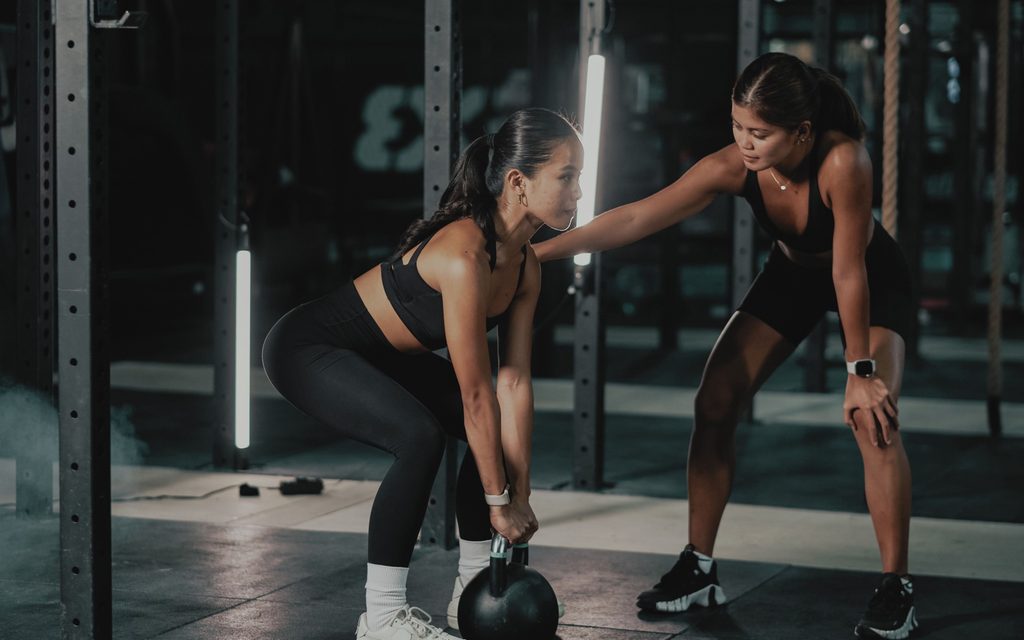
If you’re wondering how to start strength training from zero, the answer is straight forward. Train your whole body 2 to 3 days a week, build each workout around five basic movements (squat, hinge, push, pull and carry), choose weights you could lift 2 to 3 more times at the end of each set, and add a little weight or a rep each week. Count workout days, not workout intensity.
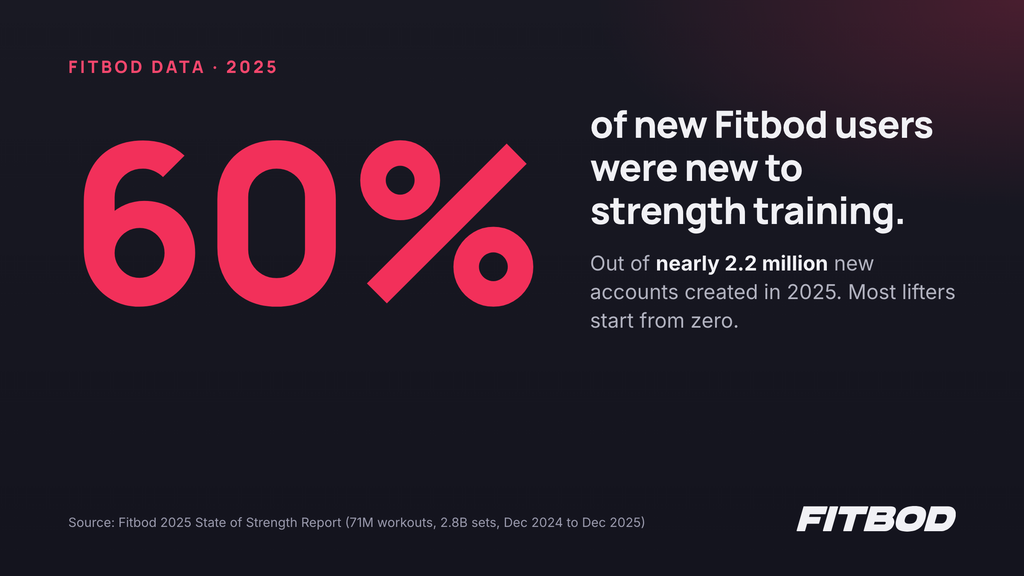
That plan works for almost anyone, and you won’t be alone. Fitbod’s 2025 State of Strength Report found that 60% of the nearly 2.2 million people who created Fitbod accounts in 2025 were new to strength training. Most lifters started where you are now.
Key Takeaways
- Two days a week is the minimum. The CDC recommends muscle-strengthening activity at least 2 days a week, covering every major muscle group.
- Beginners get stronger fast. Fitbod’s analysis of 840,000 users found a typical beginner’s estimated one-rep max rises from 110 lb to 140 lb (27%) within 20 weeks.
- New Fitbod users who train three times a week for about 45 minutes see a 34% strength increase after three months, on average.
- Workout days in month one predict the year ahead. In Fitbod’s study of 389,481 users, distinct workout days in the first 28 days was the strongest early signal of long-term adherence.
- Simple exercises stick. Fitbod’s analysis of 7 million first attempts found 70% of exercises people abandon are dropped within the first two tries.
- A plan beats guessing. Users who followed Fitbod’s AI recommendations logged 24% more personal records in 2025.
Table of Contents
- You Don’t Need Any Experience to Start
- How Often Should a Beginner Strength Train?
- Learn Five Movement Patterns
- A 3-Day Full-Body Dumbbell Program for Beginners
- How Much Weight Should a Beginner Lift?
- How to Learn to Lift Safely Without a Personal Trainer
- Start With Exercises That Are Easy to Learn
- Progressive Overload Is How You Get Stronger
- Don’t Stress About Exercise Order
- Recovery Is Part of the Program
- Count Workout Days, Not Workout Minutes
- Let Fitbod Do the Programming
- Frequently Asked Questions
1. You Don’t Need Any Experience to Start
Strength training from zero requires no prior experience, no gym membership and no special fitness level. Strength training (also called resistance training) means making your muscles work against a load, such as dumbbells, machines, resistance bands or your own body weight.
Most people who start lifting have never done it before. Fitbod’s 2025 State of Strength Report, which analyzed 71 million workouts and 2.8 billion logged sets, found that 60% of new Fitbod users were new to strength training. The report describes resistance training as a likely entry point into fitness rather than a secondary pursuit.
The barrier for most beginners isn’t strength. It’s not knowing what to do when they walk in. The rest of this list solves that problem one piece at a time.
2. How Often Should a Beginner Strength Train?
Beginners should strength train 2 to 3 days a week, with at least one rest day between sessions that work the same muscles. The CDC’s adult activity guidelines call for muscle-strengthening activity on 2 or more days a week that works the legs, hips, back, abdomen, chest, shoulders and arms.
Full-body workouts are the simplest way to hit that target. Each session trains every major muscle group, so missing a day doesn’t leave a body part untrained for two weeks.
Fitbod trainer Mike Dewar gives new clients a concrete first goal: 12 workouts in the first 30 days, or about three a week. His reasoning is that hitting 12 sessions proves you can fit training into your life, which matters more in month one than any single workout. For a deeper look at weekly structure, see Fitbod’s guide to the 3-day workout split for beginners.
3. Learn Five Movement Patterns, Not 50 Exercises
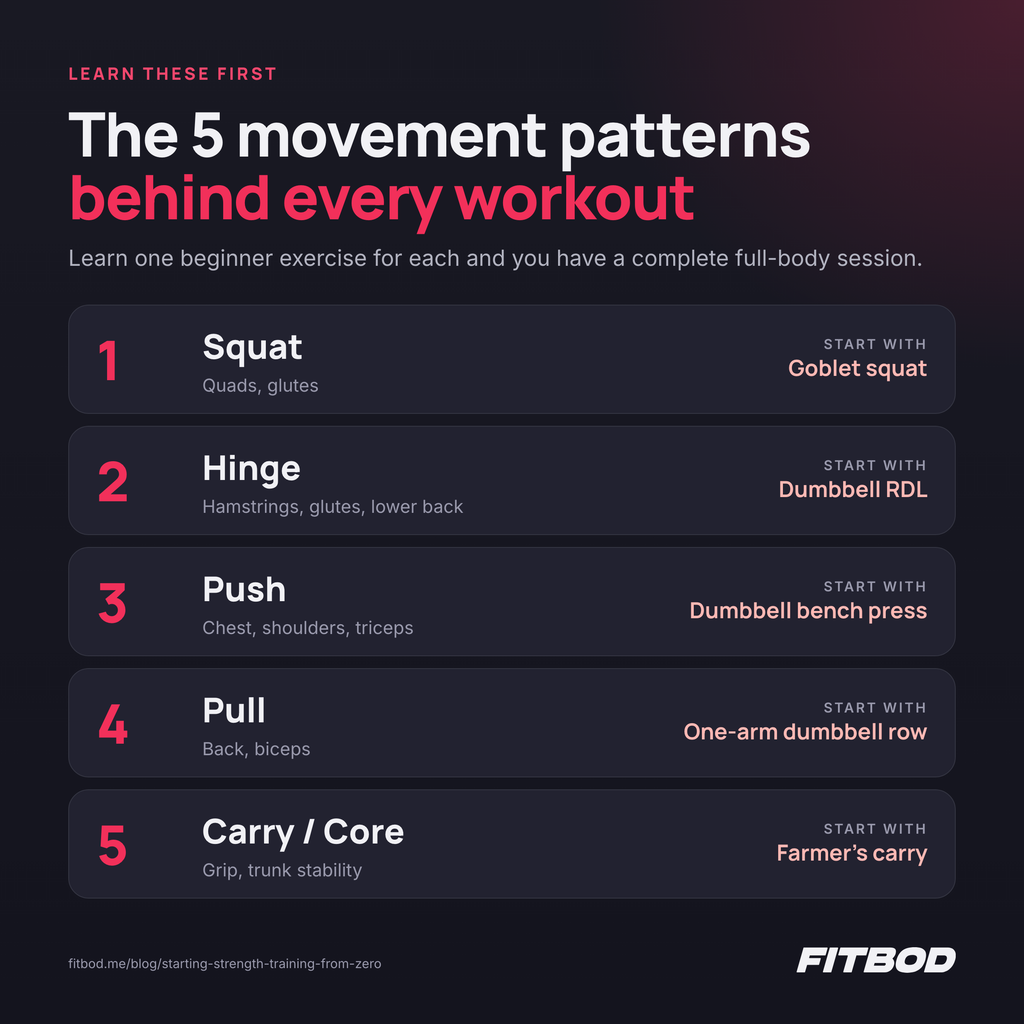
Nearly every strength exercise is a version of five movement patterns: squat, hinge, push, pull and carry. Learn one beginner-friendly exercise for each pattern and you have a complete full-body workout.
| Movement pattern | Main muscles | Beginner exercise | Progress later to |
| 1. Squat | Quads, glutes | Goblet squat | Barbell back squat |
| 2. Hinge | Hamstrings, glutes, lower back | Dumbbell Romanian deadlift | Trap-bar deadlift |
| 3, Push | Chest, shoulders, triceps | Dumbbell bench press, push-up | Barbell bench press |
| 4. Pull | Back, biceps | Dumbbell row, lat pulldown | Pull-up |
| 5. Carry / Core | Grip, trunk | Farmer’s carry, dead bug | Suitcase carry |
Compound movements like these train several muscles at once, which is why Fitbod’s beginner’s 4-week plan and its workout algorithm both anchor beginner sessions around them. You can add arm curls and calf raises later. In your first months, these five patterns do most of the work.
4. A 3-Day Full-Body Dumbbell Program for Beginners
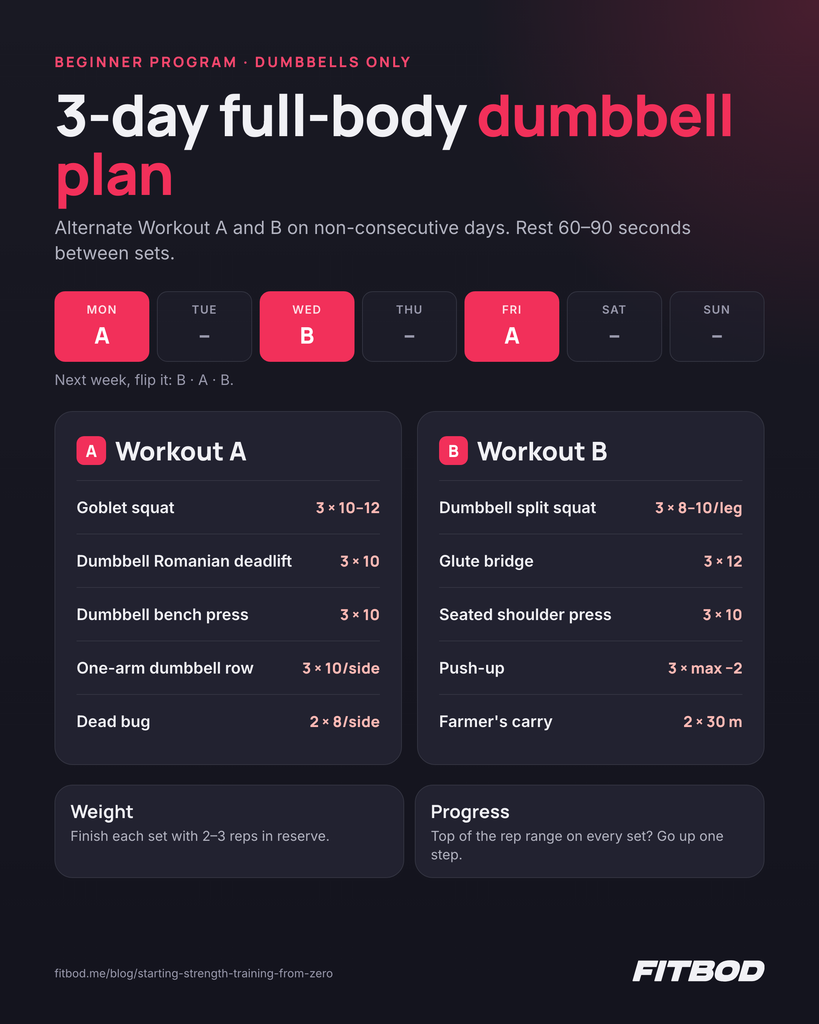
A beginner 3-day full-body dumbbell program alternates two workouts (A and B) on non-consecutive days, such as Monday, Wednesday and Friday, using 5 to 6 exercises per session at 2 to 3 sets each. All you need is a pair of dumbbells, ideally adjustable, and a bench or sturdy surface.
Run the schedule as A-B-A one week, then B-A-B the next. Rest 60 to 90 seconds between sets.
Workout A
| Exercise | Sets × reps | Rest |
| 1. Goblet squat | 3 × 10–12 | 90 sec |
| 2. Dumbbell Romanian deadlift | 3 × 10 | 90 sec |
| 3. Dumbbell bench press (or floor press) | 3 × 10 | 90 sec |
| 4. One-arm dumbbell row | 3 × 10 per side | 90 sec |
| 5. Dead bug | 2 × 8 per side | 60 sec |
Workout B
| Exercise | Sets × reps | Rest |
| 1. Dumbbell split squat | 3 × 8–10 per leg | 90 sec |
| 2. Glute bridge (dumbbell on hips) | 3 × 12 | 60 sec |
| 3. Seated dumbbell shoulder press | 3 × 10 | 90 sec |
| 4. Push-up (hands on bench if needed) | 3 × as many as you can with good form, stop 1–2 short | 90 sec |
| 5. Farmer’s carry | 2 × 30 meters | 60 sec |
Each workout covers all five movement patterns and stays under an hour, in line with Mike Dewar’s advice of 5 to 6 exercises per session, with about 90 seconds of rest. Once you can finish every set at the top of the rep range with good form, increase the weight by the smallest jump available.
A fixed plan like this is a good start. If your dumbbells only go so heavy, or you train at home some days and at a gym on others, Fitbod’s full-body dumbbell workout generator builds a version that matches the weights you actually own.
5. How Much Weight Should a Beginner Lift?
A beginner should pick a weight they can lift for every rep with good form while finishing each set with 2 to 3 reps still “in the tank.” That buffer is called reps in reserve (RIR). Mayo Clinic gives a similar rule: start with a weight you can lift comfortably 12 to 15 times.
To find that weight on day one:
- Start lighter than you think you need.
- Do one set of 10 reps.
- If you could have done 5 or more extra reps, go up one increment.
- If your form broke down before rep 10, go down.
- Write down the weight that worked.
This is the step beginners find hardest, and it’s where an app helps most. Fitbod recommends a starting weight that leaves roughly 2 to 3 reps in reserve, then adjusts future recommendations based on what you log. According to Fitbod’s 2025 State of Strength Report, Fitbod’s estimated one-rep max (1RM, the most you could lift for a single rep) lands within 2.8% of a user’s true max.
6. How to Learn to Lift Safely Without a Personal Trainer
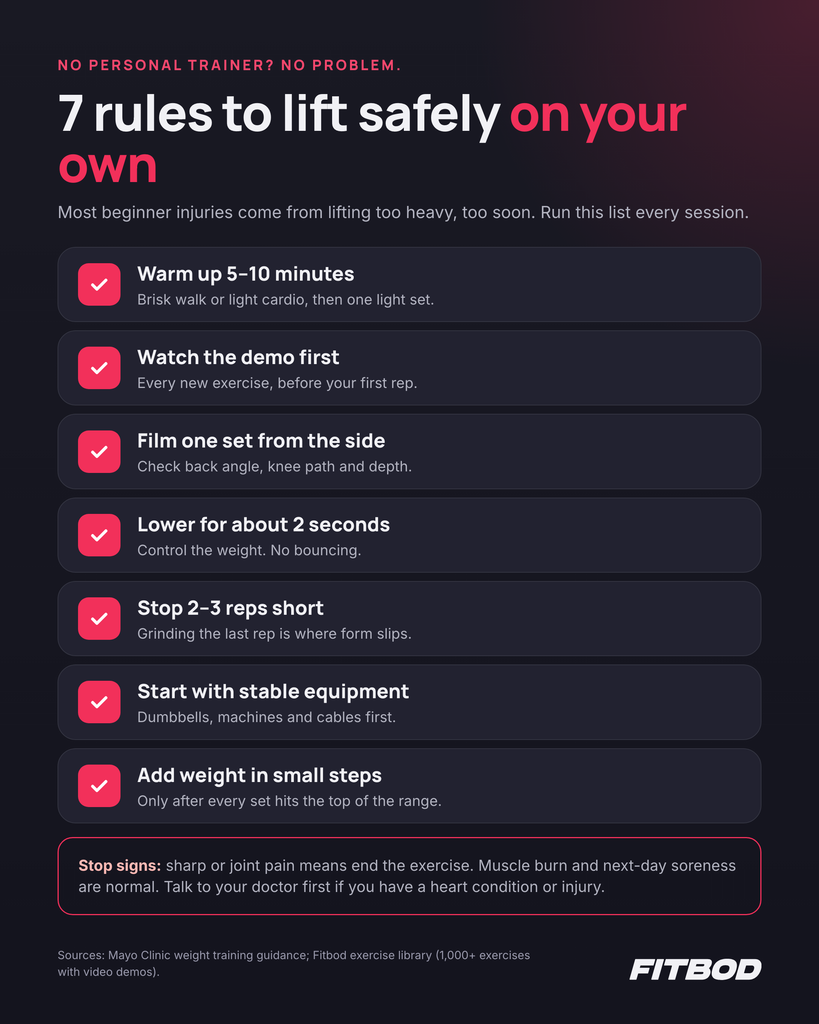
You can learn to lift weights safely without a personal trainer by starting light, learning one movement pattern at a time from video demonstrations, filming your sets to check form, and stopping each set before your technique breaks down. Most beginner injuries come from lifting too heavy too soon, not from a lack of coaching.
Use these 7 rules for every strength session:
- Warm up for 5 to 10 minutes. Mayo Clinic suggests brisk walking or other light aerobic activity before lifting. Then do one light set of your first exercise.
- Watch a demo before every new exercise. Fitbod’s library has over 1,000 exercises, each with video demos and form tips.
- Film one set from the side. Compare your back angle, knee path and range of motion with the demo.
- Move with control. Take about 2 seconds to lower the weight and don’t bounce out of the bottom.
- Stop at 2 to 3 reps in reserve. Grinding out the last rep is where form slips.
- Choose stable equipment first. Dumbbells, machines and cables are more forgiving than a heavy barbell while you learn.
- Know the stop signs. Sharp or joint pain means end the exercise. Normal muscle burn and next-day soreness are expected.
If you have a heart condition, joint injury or other health concern, talk to your doctor before starting a new exercise program.
7. Start With Exercises That Are Easy to Learn
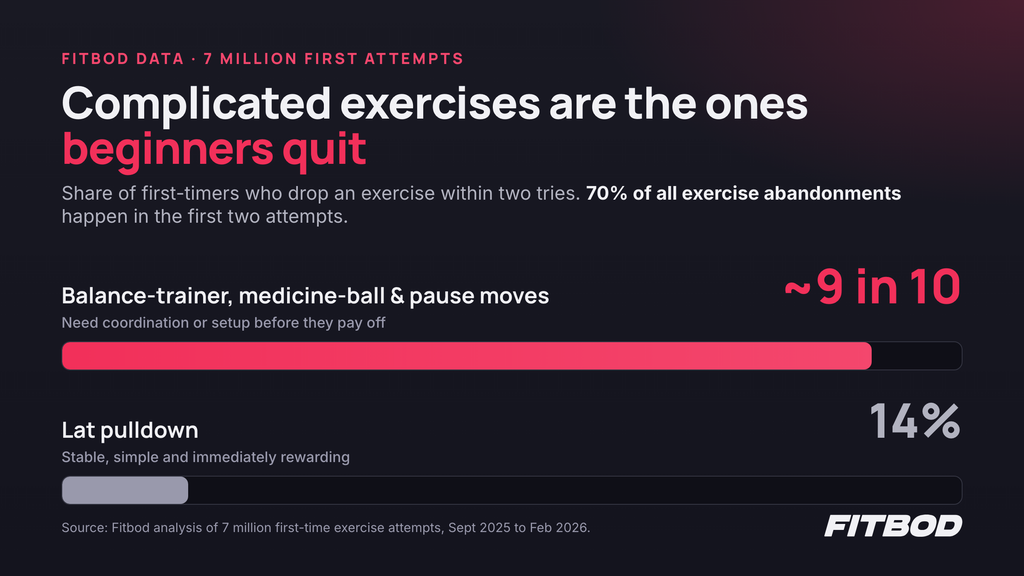
Beginners should start with stable, simple exercises because complicated movements are the ones people quit. Fitbod tracked 7 million first-time exercise attempts logged between September 2025 and February 2026 and found that 70% of all exercise abandonments happen within the first two attempts.
The pattern was clear. Balance-trainer moves, medicine-ball accessories and pause variations lost about 9 in 10 first-timers within two tries. A straightforward machine exercise like the lat pulldown lost only 14%. Fitbod’s analysis also found the risk of quitting an exercise falls nearly sixfold between the first and tenth time you perform it.
The lesson for someone starting from zero: pick exercises that feel good right away, and give each one at least a few sessions before you judge it.
8. Progressive Overload Is How You Get Stronger
Progressive overload means gradually making your workouts harder, by adding weight, reps or sets over time, so your muscles keep adapting. Without it, your body has no reason to get stronger. Fitbod’s progressive overload guide covers the methods in detail.
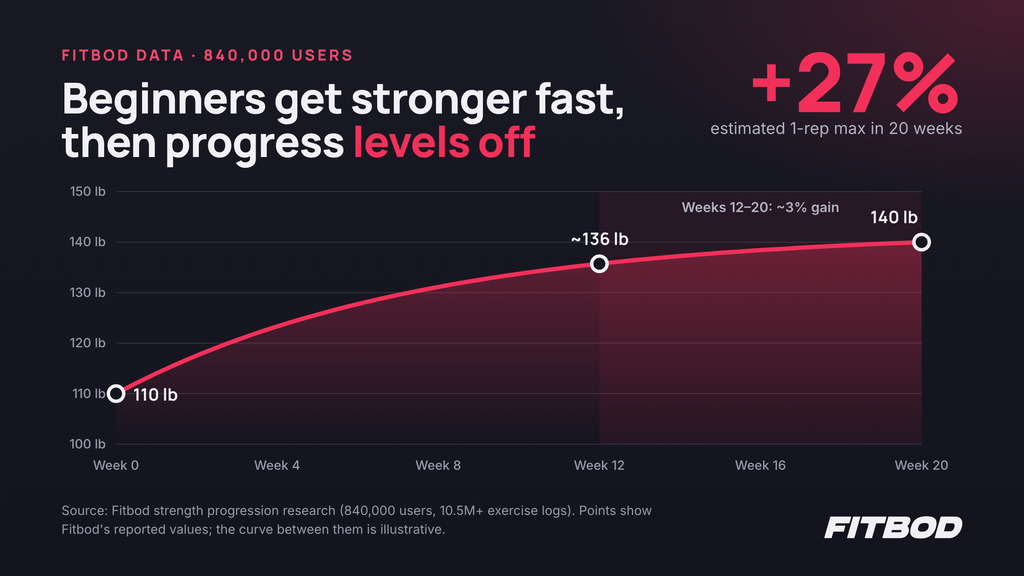
For beginners, progress comes quickly. Fitbod’s strength progression research, based on 840,000 users and more than 10.5 million exercise logs, found that a lifter starting at a 110 lb estimated 1RM can typically reach 140 lb, a 27% increase, within 20 weeks. Early gains come mostly from better coordination. Between weeks 12 and 20, progress slows to around 3.14% as muscle growth takes over.
A simple rule to follow: when you hit the top of your rep range for every set, add the smallest weight jump available next session. Fitbod’s workout algorithm applies this automatically using your logged sets and reps in reserve.
9. Don’t Stress About Exercise Order
For beginners following a structured program, exercise order barely affects results. Fitbod’s analysis of 1.5 million logged exercise sets found only a 4% difference in weight lifted between the first and seventh exercise in a Fitbod-recommended session.
A sensible default is to do your biggest lifts, like squats and deadlifts, first while you’re fresh. Beyond that, don’t let sequencing questions delay your first workout. Showing up matters far more than the order of your exercises.
10. Recovery Is Part of the Program
Muscles get stronger during recovery, not during the workout itself, so beginners need rest days between sessions that train the same muscles. Training a muscle again before it recovers can drag down performance and raise injury risk.
Soreness one or two days after a new workout is normal, especially in the first few weeks. It’s not a sign the workout was better. If a muscle is still very sore, train other muscles or take a walk instead.
Fitbod tracks this for you. The app’s Body tab shows a color-coded recovery estimate for each muscle group, and recently trained muscles aren’t prioritized again until they’ve had time to recover. Sleep, enough protein and regular meals support the same process.
11. Count Workout Days, Not Workout Minutes
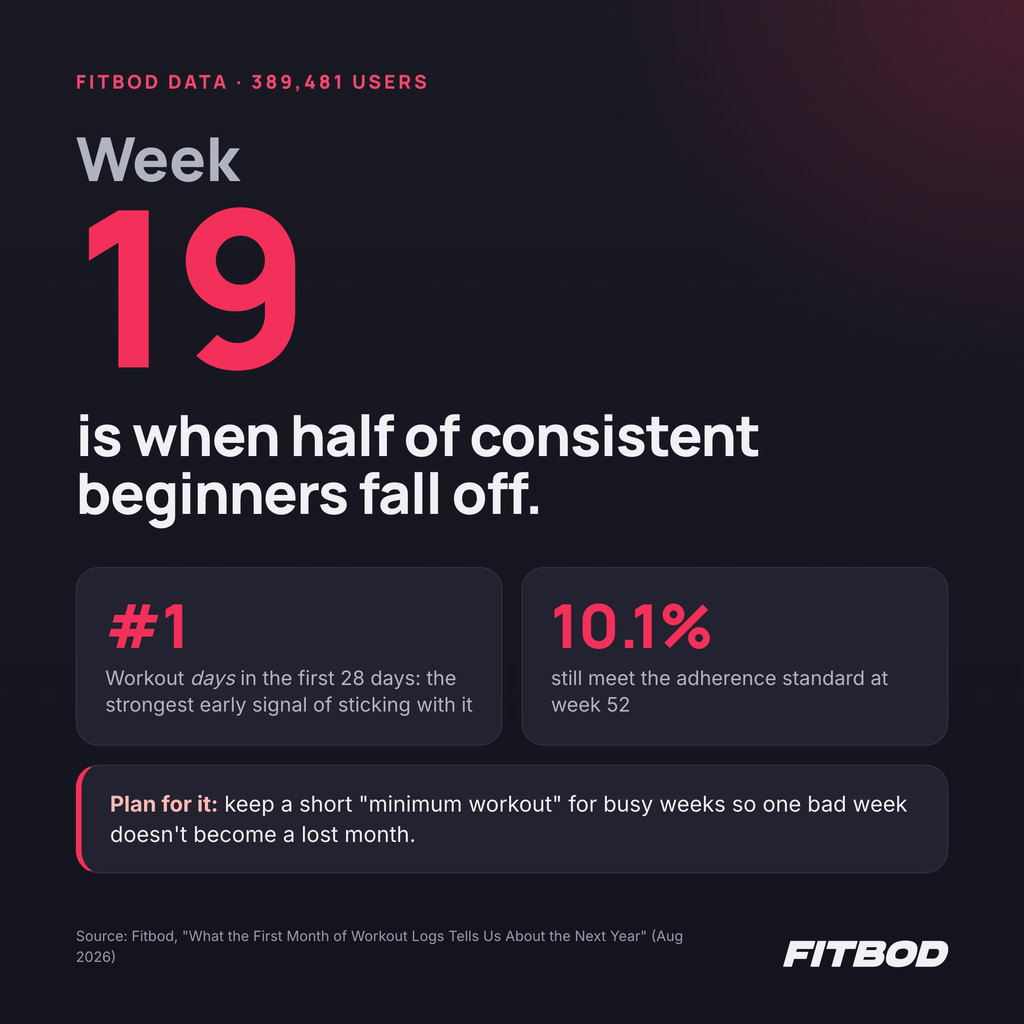
In your first month, the number of days you train matters more than how long or how hard each session is. Fitbod analyzed 12 months of workout records from 389,481 adult users and found that distinct workout days in the first 28 days was the strongest first-month signal of long-term adherence. It was a stronger signal than total workout time, equipment or exercise choice.
Even consistent beginners drift. In the same Fitbod study, half of beginners who trained in each of their first four weeks no longer met a forgiving adherence standard by week 19, and only 10.1% still met it at week 52. Fitbod’s State of Strength data shows a 52% consistency rate (2+ workouts a week) for beginner lifters, compared with 65% for advanced lifters.
The payoff for sticking with it is real. Fitbod users who trained consistently during their first three months achieved 3.6× more personal records than those who didn’t. Plan a shorter “minimum workout” for busy weeks so a bad week doesn’t become a lost month.
12. Let Fitbod do the Programming
The easiest way to start strength training from zero is to follow a plan that tells you exactly what to do each session. Guessing leads to random workouts, stalled progress and quitting.
Fitbod is built for that job. It creates personalized workouts from your goal, experience level, available equipment and muscle recovery, recommends sets, reps and weights, and updates the next workout from what you log. Users who followed Fitbod’s AI recommendations logged 24% more personal records in 2025. Fitbod has been downloaded over 15 million times and is rated 4.8 out of 5 on the App Store from 250K+ reviews.
For a side-by-side look at what to expect, read Fitbod’s guide to the best app for complete beginners, or follow the step-by-step version in How to Start Strength Training When You Have No Idea What You’re Doing.
Frequently Asked Questions
- How long does it take to see results from strength training as a beginner? Most beginners notice strength gains within 3 to 4 weeks. Early progress comes mainly from your nervous system learning the movements. Fitbod data shows new users who train three times a week for about 45 minutes see a 34% strength increase after three months, on average. Visible muscle changes usually take longer, often 8 to 12 weeks of consistent training and adequate protein.
- Can I start strength training at home with no equipment? Yes. Bodyweight exercises like squats, glute bridges, push-ups and planks cover the five main movement patterns. Add a resistance band or a pair of adjustable dumbbells when bodyweight moves get easy. Fitbod builds workouts around whatever equipment you list, including bodyweight only, and lets you save separate profiles for home and the gym.
- Should beginners lift heavy or light weights? Beginners should lift moderate weights they can control for 8 to 15 reps, ending each set with 2 to 3 reps in reserve. Very light weights won’t challenge your muscles enough, and very heavy weights make good form hard to learn. Increase the load gradually once you can complete every set at the top of your rep range.
- Is 30 minutes of strength training enough for a beginner? Yes. A focused 30-minute full-body session with 4 to 5 exercises, done 2 to 3 times a week, is enough to build strength as a beginner. Consistency matters more than session length. Fitbod’s research found that the number of workout days in the first month was a stronger predictor of sticking with training than total workout minutes.
- Do I need cardio if I’m starting strength training? Cardio isn’t required to get stronger, but it supports heart health. The CDC recommends adults get 150 minutes of moderate aerobic activity a week in addition to 2 days of muscle-strengthening activity. A brisk 5 to 10 minute walk before lifting doubles as a warm-up and counts toward that total.
- What should I do on my first day of strength training? Keep your first session short and light. Warm up for 5 to 10 minutes, then do 1 to 2 sets of 4 or 5 basic exercises, such as a goblet squat, dumbbell row, push-up, glute bridge and farmer’s carry. Focus on learning the movements and recording your weights. Your goal on day one is to leave wanting to come back.
- Is Fitbod good for people who have never lifted before? Yes. Fitbod asks for your goal, experience level and equipment, then builds each workout for you with recommended sets, reps and weights. Every exercise includes a video demo and form tips. Fitbod’s 2025 data shows 60% of new users were new to strength training, and the app adjusts recommendations as you log workouts. New users can try it with a 7-day free trial.
Final Thoughts
Starting strength training from zero feels intimidating mainly because there’s so much conflicting advice. The fundamentals are short: train two to three times a week, learn five movement patterns, start lighter than you think, add a little weight over time, rest between sessions, and protect your workout days above everything else. Fitbod’s data from millions of beginners points the same way. The people who see the biggest gains aren’t the ones with the perfect program. They’re the ones who show up in month one, month three and month six. Pick your first workout, put three days on your calendar this week, and let a plan handle the details so you can focus on lifting.


