



Your gym bag has been sitting under your desk all day. By the time you get to your first set, someone else has already posted their sunrise workout, finished breakfast and answered a dozen emails. It’s easy to wonder whether getting there earlier would get you better results.
So we checked. We looked at strength progress in more than 26,000 Fitbod users. Over roughly three months, morning and evening lifters made similar gains in estimated strength, after accounting for differences in their starting points, training habits and Fitbod’s recommendations.
Data findings based on Fitbod records from 26,000+ lifters between May 2024 – November 2026
Key Takeaways
- Morning and evening lifters got stronger at about the same rate. Across 26,000+ Fitbod users assessed 12–16 weeks apart, the evening-minus-morning difference in strength gains was just 0.28 percentage points, with a 95% confidence interval of −0.41 to +0.96 a range that includes zero.
- A 2019 meta-analysis in Chronobiology International and a 2023 meta-analysis in Sports Medicine – Open both found no meaningful overall difference in strength gains between morning and evening training.
- Evening lifters aren’t settling for slower progress and morning lifters have no reason to rearrange a routine they enjoy.
- The best training time is the one you can repeat. Fitbod’s own peer-reviewed adherence study of 389,481 users found that the number of distinct workout days is the strongest early signal of whether people keep training.
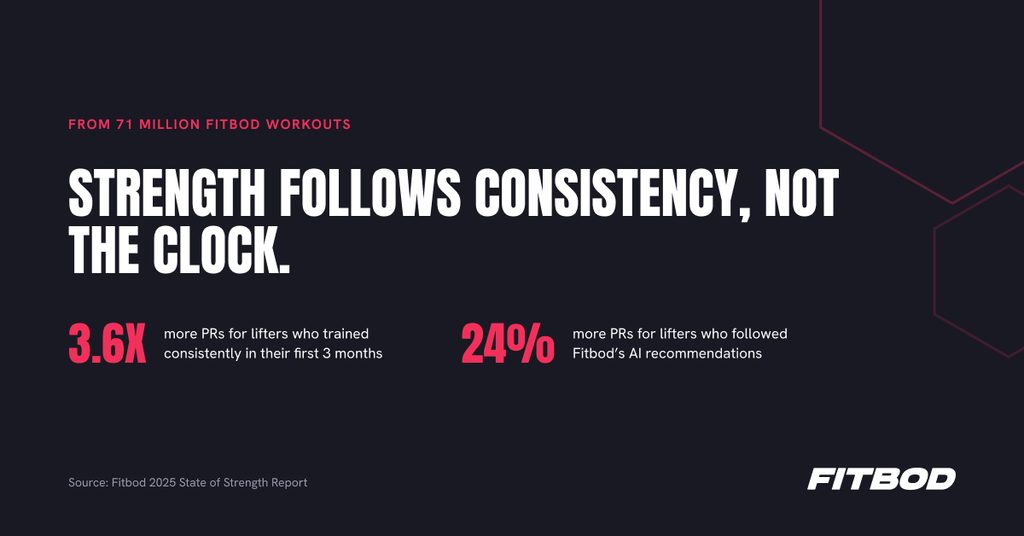
- Consistency drives results. Fitbod users who trained consistently in their first three months logged 3.6× more personal records, and users who followed Fitbod’s AI recommendations logged 24% more PRs.
- People chose their own workout times, so similar average gains don’t guarantee you’d progress identically if you switched.
Table of Contents
- Does the Time of Day You Lift Affect Strength Gains?
- What 26,000+ Fitbod Lifters Show About Morning vs. Evening Training
- What the Research Says About the Best Time to Lift
- Is It Better to Work Out in the Morning or at Night?
- How to Choose the Best Workout Time for You
- What This Study Can and Can’t Tell You
- How Fitbod Helps You Progress at Any Hour
- Frequently Asked Questions
- Final Thoughts: Strength Follows Consistency, Not the Clock
- About the Data
Does the Time of Day You Lift Affect Strength Gains?
Short answer: not in any meaningful way, on average. In Fitbod’s analysis of more than 26,000 lifters, people who mostly trained in the evening and people who mostly trained in the morning made statistically similar strength gains over 12–16 weeks.
That’s encouraging if your workout happens whenever the rest of your life allows it. If evenings are your window, our findings give you little reason to assume you’re settling for slower strength progress. And if you love getting your workout done before the day gets going, there’s reassurance for you, too: we didn’t find a substantial average evening advantage that would justify rearranging a morning routine you enjoy.
What 26,000+ Fitbod Lifters Show About Morning vs. Evening Training
How we defined morning and evening lifters
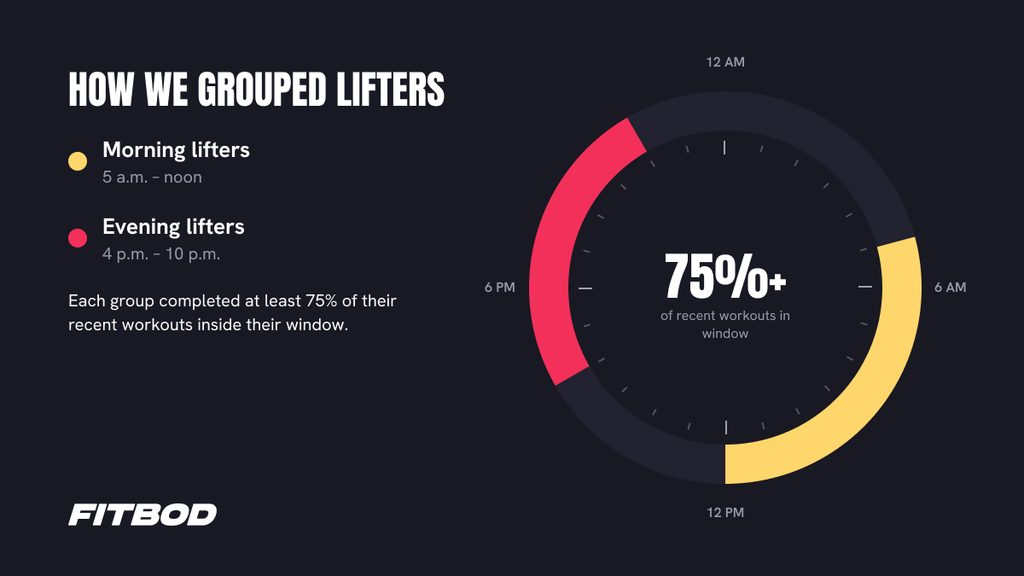
We compared two groups based on when they habitually trained, not on a single session:
| Group | Definition |
|---|---|
| Morning lifters | Completed at least 75% of their recent workouts between 5 a.m. and noon |
| Evening lifters | Completed at least 75% of their recent workouts between 4 p.m. and 10 p.m. |
Strength was estimated from the weights and reps each person logged, then compared across repeated strength assessments taken 12–16 weeks apart.
The result: a difference too small to matter
| Measure | Result |
|---|---|
| Lifters analyzed | 26,000+ |
| Time between strength assessments | 12–16 weeks |
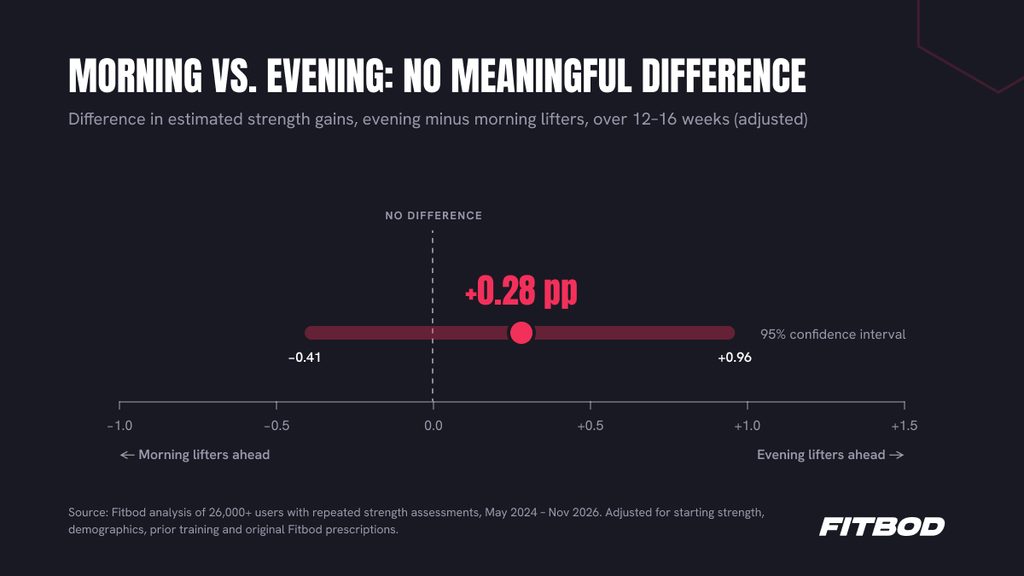
| Evening − morning difference in strength gains | +0.28 percentage points |
| 95% confidence interval | −0.41 to +0.96 |
| Robustness checks | Larger follow-up sample and recommendation-adherence checks supported the finding |
Because the confidence interval spans zero, the data doesn’t support a real advantage for either group. Even at the top of that range, the evening edge would be under one percentage point of strength gain over three months.
What we adjusted for
Morning and evening lifters aren’t identical people, so the comparison accounts for:
- Starting strength — stronger lifters tend to progress more slowly
- Demographics — such as age and sex
- Prior training history — how much and how consistently people had trained before
- Fitbod’s original recommendations — the workouts the algorithm prescribed at the start of each assessment window
What the Research Says About the Best Time to Lift
Our results line up with controlled studies where researchers assigned participants to morning or evening training.
Meta-analyses find no overall winner
- A 2019 systematic review and meta-analysis led by Jozo Grgic and Brad Schoenfeld in Chronobiology International found that morning and evening resistance training produced similar increases in muscle strength and muscle size.
- A 2023 systematic review and meta-analysis by Fabienne Bruggisser, Frank Scheer and colleagues in Sports Medicine – Open reached the same overall conclusion: no clear difference in strength gains between morning and evening training, with the authors noting that the certainty of evidence was low and that personal preference can reasonably guide the choice.
- An earlier randomized trial by Sedliak and colleagues (2009) in the Journal of Strength and Conditioning Research found similar muscle hypertrophy in men who trained in the morning versus the evening over 10 weeks.
Why you may feel stronger later in the day
Single-session performance does tend to follow a daily rhythm: strength and power often peak in the late afternoon or early evening, when body temperature is higher (Drust et al., Chronobiology International, 2005). That’s a difference in how one workout feels, not in how much stronger you get over months.
The “time-of-day specificity” effect
Both meta-analyses found hints that people may perform slightly better when they’re tested at the same time of day they train. Practically, if you have a meet or test at a set time, it can help to train near that time in the weeks leading up to it. For everyday lifters, it’s another argument for simply staying consistent with your usual window.
Is It Better to Work Out in the Morning or at Night?
Neither is better for strength. Each has practical trade-offs worth weighing:
| What to Expect | Morning workouts | Evening workouts |
|---|---|---|
| Biggest upside | Done before work, family or meetings can interfere | More time to warm up and rest between sets without watching the clock |
| Common challenge | Stiffness and lower body temperature early on | Workday fatigue, schedule spillover, late meals |
| Make it work | Extend your warm-up; keep a light pre-lift snack ready | Plan sessions around dinner; leave a buffer before bed if training keeps you wired |
| Strength gains (Fitbod data) | Similar | Similar |
Maybe an early session gives you an hour before anyone needs something from you. Maybe training after work means you can take your time between sets. Those are real reasons to prefer one schedule over another and they matter more than the clock itself.
How to Choose the Best Workout Time for You
Pick the window you can protect
Fitbod’s peer-reviewed study of 389,481 users found that the number of distinct workout days in the first month was the strongest early signal of long-term adherence — stronger than total workout time, equipment or exercise choice. The hour that reliably makes it onto your calendar beats the “optimal” hour you keep missing.
Notice when you arrive ready to train
Ask yourself:
- When do I usually show up with energy and focus?
- Which sessions are hardest to fit into my week?
- What does my workout history show about which days I actually complete?
A schedule that looks impressive on someone else’s feed may be awkward in your calendar.
Protect your sleep
In general, adults need 7 or more hours of sleep per night for health, according to the American Academy of Sleep Medicine and Sleep Research Society consensus. If a 5 a.m. alarm costs you sleep, or late training keeps you up, that trade-off may matter more than the timing itself.
Hit your weekly minimum
The U.S. Physical Activity Guidelines for Americans recommend muscle-strengthening activity involving all major muscle groups on at least 2 days per week. Morning, afternoon or evening, every session counts.
What This Study Can and Can’t Tell You
There’s a limit to what our data can tell you:
- People chose their own workout times; we didn’t assign them. This is an observational study, not a randomized trial.
- Similar averages don’t guarantee individual results. You might not feel or progress exactly the same if you switched.
- Unmeasured factors may still matter. Sleep, work schedules and other differences we couldn’t fully measure could play a role.
- The sample is specific. Results describe Fitbod users with repeated strength assessments, not every Fitbod user.
But the core finding is reassuring: people made strength progress with both routines.
How Fitbod Helps You Progress at Any Hour
Fitbod adapts the workout to you, whenever you train:
- Recovery-aware programming. Each muscle group gets a recovery score from 0 to 100%, so an evening session after a morning one the day before still targets fresh muscles.
- Automatic progressive overload. Fitbod applies progressive overload automatically as you log sets, and its 1RM estimates land within ±2.8 lb on average (Fitbod 2025 State of Strength Report).
- Short sessions still count. Users who consistently trained in sessions of 10 minutes or less averaged 32 personal records in 2025 (State of Strength Report) — useful when your window is tight.
- Train wherever the day takes you. With 1,000+ exercises and equipment profiles for bodyweight, bands or a full gym, and Fitbod users training at an average of 2.5 different gyms, your plan fits a hotel gym at 6 a.m. or your garage at 8 p.m.
- Progress you can see. Your estimated 1RM, per-muscle mStrength and Strength Score update with every logged set, so you can judge your schedule by your own trend line.
Frequently Asked Questions
- Is it better to lift weights in the morning or evening? For long-term strength gains, neither is clearly better. Fitbod data from 26,000+ lifters showed a difference of just 0.28 percentage points over 12–16 weeks (95% CI: −0.41 to +0.96), and published meta-analyses reach the same conclusion. Choose the time you can stick with.
- Do you build more muscle working out at night? Controlled studies, including a 2019 meta-analysis, found similar increases in muscle size for morning and evening training. Consistency, progressive overload, protein intake and sleep matter far more than the hour.
- Why do I feel stronger in the evening? Strength and power often peak in the late afternoon or early evening, partly because body temperature is higher. That can make a single session feel better, but it hasn’t been shown to produce meaningfully bigger strength gains over time.
- Is it bad to lift weights right before bed? Not necessarily. If late workouts make it harder for you to fall asleep, leave more time between training and bedtime or move the session earlier. Getting 7+ hours of sleep supports recovery regardless of when you train.
- Should I switch my workout time to get better results? If your current routine fits your life and your lifts are progressing, the evidence offers little reason to overhaul it. Switch only if a different time would make you more consistent, better rested or more focused.
- Does training at the same time every day matter? Research suggests a small “time-of-day specificity” effect: you may perform slightly better at the time you usually train. A consistent window also makes the habit easier to keep which, according to Fitbod’s adherence research, is what predicts long-term training.
- How many days a week should I strength train? U.S. guidelines recommend at least 2 days per week of muscle-strengthening activity for all major muscle groups. Fitbod adjusts each workout to your schedule and muscle recovery, whether you train 2 or 6 days a week.
Final Thoughts: Strength Follows Consistency, Not the Clock
The most useful way to read this study isn’t “evening lifters are fine, too” it’s that the time of day turned out to be one of the least important variables in getting stronger. Across more than 26,000 Fitbod lifters, after adjusting for starting strength, demographics, prior training and the workouts Fitbod originally prescribed, the gap between morning and evening progress was 0.28 percentage points over 12–16 weeks, with a confidence interval running from slightly negative to just under one point. That’s consistent with the controlled research: the 2019 Grgic and Schoenfeld meta-analysis and the 2023 Bruggisser and Scheer meta-analysis both found no meaningful overall difference in strength gains between morning and evening training. Two very different kinds of evidence, real-world logs and randomized trials, point the same direction.
What does move the needle shows up clearly in Fitbod’s data. In Fitbod’s peer-reviewed study of 389,481 users, the number of distinct days people trained in their first month was the strongest early predictor of whether they kept going. The 2025 State of Strength Report, drawn from 71 million workouts and 2.8 billion sets, found that users who trained consistently in their first three months logged 3.6× more personal records, and those who followed Fitbod’s AI recommendations logged 24% more PRs. Frequency, consistency and progressive overload are the levers; the hour on the clock is mostly a scheduling decision.
That reframes how to choose your training time. Instead of asking “When is optimal?”, ask three practical questions: Which window can I protect most weeks? When do I arrive with enough energy to train with good form and effort? And which option protects my sleep, the 7+ hours that sleep-medicine experts recommend and that recovery depends on? If you compete or test your max at a fixed time, it may be worth training near that time to take advantage of time-of-day specificity. Otherwise, let your own logged progress be the judge: if your estimated 1RM and Strength Score are trending up, your schedule is working.
It’s also worth being honest about what this study doesn’t settle. People chose their own training times, so it can’t prove that switching would leave your results unchanged, and factors like sleep quality and work stress weren’t fully measured. But the finding itself is reassuring: lifters made real strength progress with both routines. When you finally pick up that gym bag after work, you have evidence that lifters with a schedule like yours were getting stronger, too.
About the Data
We compared repeated strength assessments taken 12–16 weeks apart using Fitbod records from May 2024 through November 2026. Morning and evening groups completed at least 75% of their recent workouts between 5 a.m.–noon or 4–10 p.m., respectively. Strength was estimated from logged weights and reps. After adjustment for starting strength, demographics, prior training and original test prescriptions, the evening–morning difference was 0.28 percentage points in gains (95% confidence interval: −0.41 to +0.96). Larger follow-up and recommendation-adherence checks supported the finding. Results describe users with repeated assessments, rather than every Fitbod user.
