


You don’t need a squat rack or a leg press to build strong legs. A few resistance bands, some floor space, and the right exercises can strengthen your quads, glutes, hamstrings, and the small hip muscles that help keep your knees stable.
Below are 10 of the best resistance band exercises for strong legs and knees. Each one includes form cues, recommended sets and reps, and data from the millions of sets Fitbod users have logged.
If you want a program that picks the right band exercises for you and adjusts your sets and reps as you get stronger, try the Fitbod app.
Key Takeaways
- Bands build strength about as well as weights. A 2019 meta-analysis in SAGE Open Medicine found that elastic resistance training produced strength gains similar to training with machines and dumbbells, in both the upper and lower body.
- Strong hips support healthy knees. A review in the British Journal of Sports Medicine found that adding hip strengthening to knee exercise reduces pain and improves function in people with kneecap (patellofemoral) pain.
- Fitbod users train with bands at scale. Users have logged more than 298,000 sets of the mini loop band glute bridge, 297,000 sets of the fire hydrant, and 218,000 sets of the lateral walk, according to Fitbod’s mini loop band exercise library.
- The best band leg workout mixes three things: a squat or lunge for the quads, a hinge or bridge for the glutes and hamstrings, and abduction work (lateral walks, clamshells) for hip and knee stability.
- Showing up matters most. A peer-reviewed study of 389,481 Fitbod users found that the number of distinct days you work out in your first month is the strongest early predictor of sticking with strength training. It mattered more than total workout time, equipment, or exercise choice.
- Stop if an exercise causes sharp knee pain. Muscle burn is normal. Joint pain isn’t. See a doctor or physical therapist if pain lasts or follows an injury.
Table of Contents
- Why Resistance Bands Work for Leg and Knee Strength
- 1. Mini Loop Band Squat
- 2. Handle Band Squat
- 3. Mini Loop Band Lateral Walk
- 4. Mini Loop Band Side-Lying Clam
- 5. Mini Loop Band Glute Bridge
- 6. Banded Glute Bridge with Alternating Leg Raise
- 7. Mini Loop Band Fire Hydrant
- 8. Mini Loop Band Standing Hip Extension
- 9. Loop Band Romanian Deadlift
- 10. Mini Loop Band Lunge
- Sample Resistance Band Leg Workout for Strong Knees
- How to Choose the Right Resistance Band
- FAQs
- Final Thoughts
Why Resistance Bands Work for Leg and Knee Strength
Your knee sits between two big joints, the hip and the ankle, and the muscles around those joints control much of how it moves. When the glutes and hip abductors are weak, the thigh tends to rotate and collapse inward during squats, lunges, and stair climbing. That puts extra stress on the kneecap and the tissues around it. In a widely cited review in the Journal of Orthopaedic & Sports Physical Therapy, Dr. Christopher Powers linked poor hip control to altered knee mechanics and common knee injuries.
Resistance bands address this problem in three ways:
- They train the hip stabilizers. Lateral walks, clamshells, and fire hydrants load the gluteus medius, a key muscle for keeping your knee from caving in.
- They load your legs without heavy weight on your joints. With bands you stand on, like a handle band, tension is lowest at the bottom of a squat, where your knees are most bent, and highest near the top, where they’re straighter and more stable.
- They teach good alignment. A mini band above your knees pulls them inward. Fitbod’s exercise guides note that resisting that pull recruits smaller stabilizing muscles, which helps you build better squat form before you add heavier weight.
Bands aren’t a compromise, either. The Lopes et al. meta-analysis pooled seven studies covering people aged 15 to 88 and found no meaningful difference in strength gains between elastic and conventional resistance. And for people with knee osteoarthritis, the American College of Rheumatology’s 2019 guideline strongly recommends exercise as a core part of treatment.
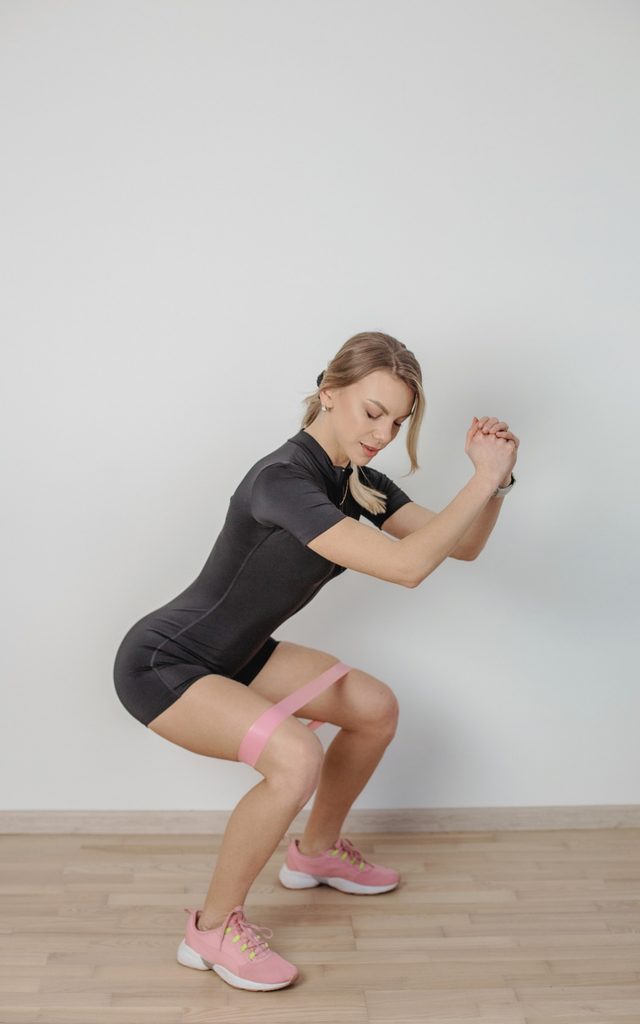
1. Mini Loop Band Squat
Targets: Quads, glutes, hip abductors Fitbod data: 168,310 sets logged
The mini loop band squat is the foundation of a knee-friendly band leg workout. With the band just above your knees, every rep teaches you to keep your knees in line with your toes.
How to do it:
- Place a mini loop band around your thighs, just above your knees, and set your feet slightly wider than shoulder-width so the band is taut.
- Brace your core, keep your back straight, and look forward.
- Push your hips back, then lower into a squat while pressing your knees out against the band.
- Pause briefly with your weight spread evenly across your feet, then drive through your legs to stand.
Form tip: Fitbod’s instructions cue you to keep your knees in line with your toes as you resist the band. If deep squats bother your knees, squat to a box or bench and work toward more depth over time.
Sets and reps: 3–4 sets of 12–15 reps.
2. Handle Band Squat
Targets: Quads, glutes Fitbod data: 292,436 sets logged
When you’re ready for more resistance, move to the handle band squat. Because you stand on a long band and hold handles at your shoulders, the band resists the whole movement rather than just your knee position. It’s one of the most-logged band leg exercises on the Fitbod app, and Fitbod’s resistance band leg workout programs it at 4 sets of 9 reps.
How to do it:
- Stand on the middle of the band with your feet shoulder-width apart.
- Hold the handles at shoulder height, palms facing forward.
- Bend your knees and push your hips back to lower into a squat, keeping your knees tracking over your toes.
- Straighten your legs to stand, squeezing your glutes at the top.
Form tip: Band tension builds as you stand up, so the squat is hardest near the top, where your knees are straighter, and easiest at the bottom. That makes it a good option if heavy, deep squats aggravate your knees.
Sets and reps: 3–4 sets of 8–12 reps.
3. Mini Loop Band Lateral Walk
Targets: Gluteus medius, hip abductors Fitbod data: 218,757 sets logged
If you only add one exercise from this list for your knees, make it the lateral walk. It strengthens the gluteus medius, which helps keep your knee from caving inward when you squat, lunge, or run.
How to do it:
- Place a band just above your knees (or around your ankles for more of a challenge), feet hip-width apart.
- Lower into a quarter squat and hold that height throughout.
- Step sideways with one foot, then bring the other foot in the same direction until your feet are back at hip-width.
- Take 10–15 steps in one direction, then return.
Form tip: Don’t let your feet come together between steps, and keep your toes pointing forward. You should feel it in the sides of your hips and glutes.
Sets and reps: 3 sets of 10–15 steps each direction.
4. Mini Loop Band Side-Lying Clam
Targets: Gluteus medius, hip external rotators Fitbod data: 143,814 sets logged
The side-lying clam is a physical therapy staple for good reason. It targets the hip rotators and gluteus medius while putting almost no load on the knee, so it’s a smart starting point if your knees are sensitive right now.
How to do it:
- Lie on your side with a band just above your knees, hips bent about 45 degrees and knees bent about 90 degrees.
- Stack your hips and keep your feet together.
- Raise your top knee as high as you can while keeping your feet touching.
- Pause, then lower slowly. Switch sides after your set.
Form tip: Rest your top hand on your hip to make sure your torso isn’t rolling backward. Smaller, controlled reps beat big, sloppy ones.
Sets and reps: 2–3 sets of 15–20 reps per side.
5. Mini Loop Band Glute Bridge
Targets: Glutes, hamstrings Fitbod data: 298,632 sets logged, the most of any lower-body exercise in Fitbod’s mini loop band library
The mini loop band glute bridge is the most-logged lower-body mini band exercise on Fitbod. Your knees stay bent in one fixed position, so your glutes and hamstrings do the work while the band challenges your hips to keep your knees from drifting together. Fitbod programs it as a timed hold at the top, and an isometric hold like this is a joint-friendly way to build strength.
How to do it:
- Lie on your back with your knees bent, feet flat and shoulder-width apart, and a band just above your knees.
- Squeeze your glutes to lift your hips off the floor until your body forms a straight line from shoulders to knees.
- Don’t let the band pull your knees inward.
- Hold the top position for the set time, then lower with control. (You can also perform it for reps.)
Form tip: If you feel this in the front of your knees, walk your feet slightly farther from your hips. If you feel it mostly in your hamstrings, bring them a little closer.
Sets and reps: 3 holds of 20–30 seconds, or 3 sets of 15–20 reps.
6. Banded Glute Bridge with Alternating Leg Raise
Targets: Glutes, hamstrings, quads, hip stability Fitbod data: 35,323 sets logged
Once the bridge hold feels easy, progress to the banded glute bridge with alternating leg raise, an intermediate move in Fitbod’s library. Shifting your weight onto one leg makes the working glute carry more of the load and forces your hips to resist rotating. The extended leg also gets quad work, without any load on the knee.
How to do it:
- Set up as you would for a mini band glute bridge, with the band just above your knees.
- Drive your hips up and hold them there for the whole set.
- Shift your weight onto one foot, then straighten the other leg, pressing that heel away from you.
- Pause, lower the foot, and switch sides.
Form tip: Keep your hips level as you extend each leg. If one side drops, shorten the hold or go back to the standard bridge.
Sets and reps: 3 sets of 8–10 reps per side.
7. Mini Loop Band Fire Hydrant
Targets: Gluteus medius, hip abductors Fitbod data: 297,223 sets logged
The mini loop band fire hydrant is second only to the glute bridge among Fitbod’s lower-body mini band exercises. It works the outer hip from all fours, so your knees aren’t bending under load while your hip stabilizers do the work.
How to do it:
- Start on all fours with your knees under your hips and a band just above your knees.
- Keep your knee bent at 90 degrees and lift one leg out to the side.
- Raise it as high as you can without shifting your weight or rotating your torso, keeping a neutral spine.
- Lower with control and repeat, then switch sides.
Form tip: Keep the supporting knee planted and don’t let it get pulled inward by the band. Once you’ve mastered the basic version, try the fire hydrant circle for an extra challenge. If kneeling is uncomfortable, put a folded towel or mat under your knees.
Sets and reps: 3 sets of 12–15 reps per side.
8. Mini Loop Band Standing Hip Extension
Targets: Glutes, hamstrings, balance on the standing leg Fitbod data: 275,701 sets logged
The standing hip extension is a two-for-one exercise. The moving leg trains the glute, while the standing leg works to keep your knee and hip stable on one foot. That single-leg control carries over to stairs, running, and everyday movement.
How to do it:
- Stand tall with your feet hip-width apart and a band around both ankles. Hold a wall or chair for balance if needed.
- Keep a slight bend in your standing knee.
- Kick one straight leg back behind you, squeezing your glute, without arching your lower back.
- Return slowly and repeat, then switch sides.
Form tip: Keep your standing knee soft and pointed straight ahead. Don’t let it collapse inward as you kick.
Sets and reps: 3 sets of 12–15 reps per side.
9. Loop Band Romanian Deadlift
Targets: Hamstrings, glutes, lower back Fitbod data: 43,707 sets logged
Strong hamstrings help support the back of the knee and balance out quad-heavy training. The loop band Romanian deadlift trains them through a hip hinge, where your knees stay slightly bent and barely move.
How to do it:
- Stand on one end of a long loop band and hold the other end with both hands. Adjust your grip to set the tension.
- Brace your core, keep your back straight, and allow a slight bend in your knees.
- Push your hips back until you feel a stretch in your hamstrings.
- Drive your hips forward and squeeze your glutes to stand tall.
Form tip: Think “hips back,” not “chest down.” Your knee angle should stay about the same from start to finish.
Sets and reps: 3–4 sets of 10–12 reps.
10. Mini Loop Band Lunge
Targets: Quads, glutes, hip stabilizers Fitbod data: 89,083 sets logged
Lunges are one of the best single-leg exercises you can do, but they can bother sensitive knees. The mini loop band lunge adds a band above your knees, which cues your front knee to stay in line with your toes instead of drifting inward.
How to do it:
- Place a band just above your knees and stand with feet hip-width apart.
- Step one foot forward and bend both knees, lowering until your back knee lightly touches or nearly touches the floor.
- Keep your front knee over your toes and resist the band’s inward pull.
- Push through your front foot to return to standing, then switch legs.
Form tip: If forward lunges bother your knees, try a reverse lunge (stepping backward). Many people find it gentler on the front knee. For a more advanced version, try the lunge kickback.
Sets and reps: 3 sets of 8–10 reps per side.
Sample Resistance Band Leg Workout for Strong Knees
Here’s a simple workout that puts these exercises together. Do it 2–3 times per week, with at least one rest day between sessions.
| Order | Exercise | Sets x Reps | Purpose |
|---|---|---|---|
| Warm-up | Side-Lying Clam | 2 x 15/side | Activate hip stabilizers |
| Warm-up | Lateral Walk | 2 x 12 steps/direction | Prime knee alignment |
| 1 | Mini Loop Band Squat or Handle Band Squat | 3 x 12 | Quad strength |
| 2 | Mini Loop Band Glute Bridge (or leg raise progression) | 3 x 30-sec hold | Glute strength |
| 3 | Loop Band Romanian Deadlift | 3 x 10 | Hamstring strength |
| 4 | Mini Loop Band Lunge (or reverse lunge) | 3 x 8/side | Single-leg strength |
| 5 | Fire Hydrant | 2 x 12/side | Hip stability finisher |
Rest 45–90 seconds between sets. When you can complete every rep with good form, switch to a heavier band or add 2–3 reps per set.
Short sessions still count. Fitbod’s 2025 State of Strength Report, which analyzed 71 million workouts, found that users who consistently trained in sessions of 10 minutes or less still averaged 32 personal records (PRs) over the year. Users who trained consistently in their first three months earned 3.6x more PRs.
How to Choose the Right Resistance Band
Most people need two types of bands for this workout:
- Mini loop bands: Short, flat loops worn above the knees or around the ankles. Best for lateral walks, clamshells, bridges, and fire hydrants. Buy a set with light, medium, and heavy options.
- Long loop or handle bands: Longer bands you stand on. Best for squats, Romanian deadlifts, and other movements that need more resistance.
Rule of thumb: The last 2–3 reps of each set should feel challenging. If you can easily do 25 or more reps, go heavier. If your knees cave in, go lighter.
The Fitbod app builds workouts around the equipment you have, including bands, and adjusts each session based on your recovery and performance. In Fitbod’s 2025 report, users who followed the app’s AI recommendations achieved 24% more PRs. Fitbod has been downloaded more than 15 million times, has a 4.8 rating and over 250,000 reviews, and its users have logged more than 120 million workouts (fitbod.me).
FAQs
- Are resistance bands good for knee pain? For many people, yes. Bands let you strengthen your quads, glutes, and hip stabilizers without heavy weight loading your joints. A review in the British Journal of Sports Medicine supports combining hip and knee strengthening for kneecap pain. If your knee pain is sharp, persistent, or followed an injury, see a doctor or physical therapist before starting.
- Can you build leg muscle with only resistance bands? Yes. A meta-analysis in SAGE Open Medicine found that elastic resistance builds strength about as well as conventional weights. For muscle growth, a 2017 meta-analysis by Schoenfeld et al. found that lighter loads build similar muscle to heavy loads when sets are taken close to failure. The key is progressive overload: move to heavier bands or add reps as you get stronger.
- What is the best resistance band exercise for knee stability? The lateral walk and the side-lying clam are two of the best. Both strengthen the gluteus medius, which helps control how your thigh moves and keeps your knee from caving inward. Fitbod users have logged more than 218,000 sets of the lateral walk.
- Where should the band go for leg exercises, above or below the knee? For most exercises on this list, place the band just above your knees. That position challenges your hip muscles without pulling directly on the knee joint. Moving the band down to your ankles makes lateral walks harder, so save that for when you’re ready to progress. Avoid placing a band directly over your kneecap.
- How often should I do resistance band leg exercises? Two to three times per week works well for most people, with at least one rest day between sessions. Regularity matters most. A study of 389,481 Fitbod users published in Frontiers in Sports and Active Living found that the number of distinct workout days in your first month was the strongest early predictor of long-term adherence.
- What resistance band exercises should I avoid with bad knees? If you have knee pain, you may want to hold off on jump squats, deep forward lunges, and fast plyometric moves until your pain settles. Start with lower-impact options like clamshells, bridges, and lateral walks, then add squats and lunges as your tolerance improves.
Final Thoughts
Strong knees start with strong hips, quads, and hamstrings, and resistance bands are one of the simplest ways to build all three. They’re inexpensive, portable, and easy on your joints, and research shows they build strength about as well as traditional weights. The 10 exercises above cover the key patterns: squats and lunges for the quads, bridges and hinges for the glutes and hamstrings, and abduction work like lateral walks and fire hydrants for the hip stabilizers that keep your knees tracking where they should.
Start light, train two to three times per week, and progress when the last few reps feel easy. Above all, keep showing up. Fitbod’s own research shows that the number of days you train early on is the strongest predictor of long-term consistency.
Want a band workout that adapts to you? Download Fitbod, add resistance bands to your equipment, and get a personalized leg plan that tracks your progress, balances your recovery, and tells you when it’s time to push harder.
This article is for educational purposes and is not medical advice. Consult a healthcare provider before starting a new exercise program, especially if you have a knee injury or chronic pain.
