


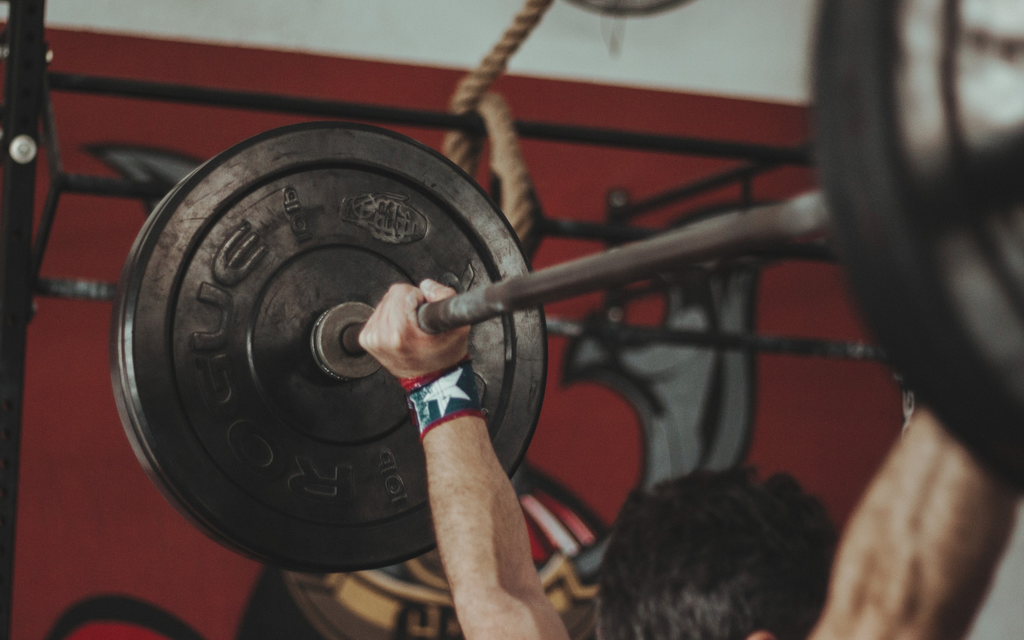
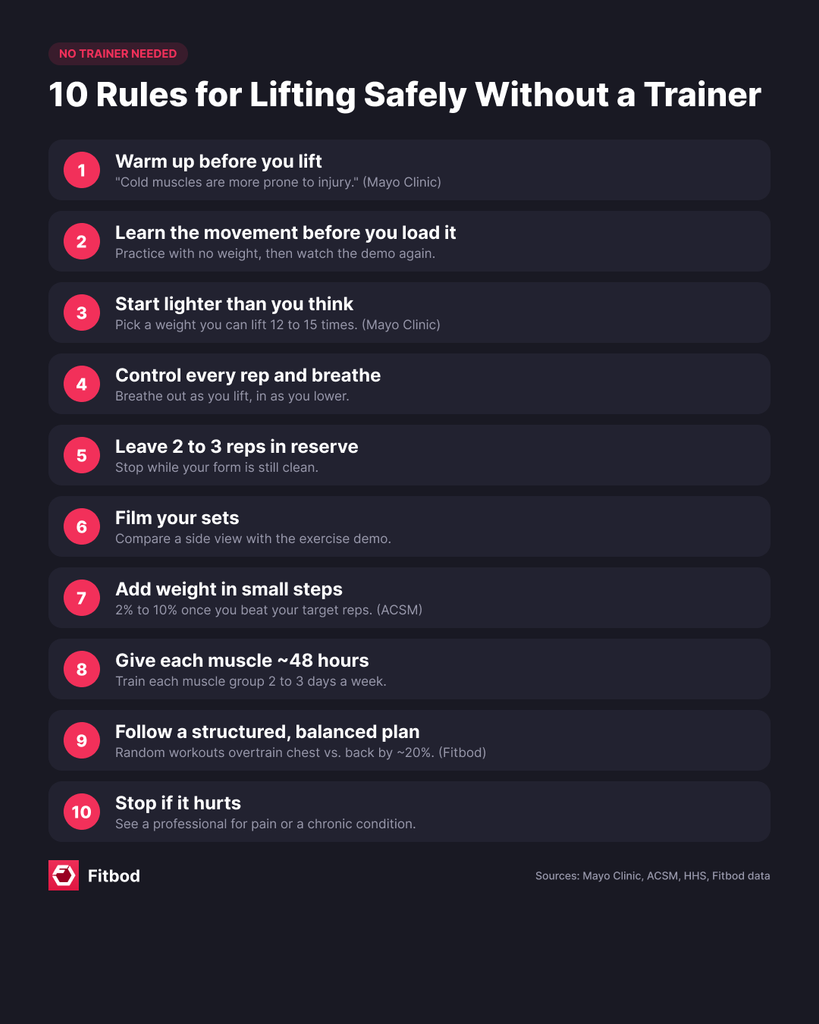
Short answer: Yes. You can learn to lift safely without a personal trainer. Warm up before every session, learn each movement with no weight or very light weight, start with a load you can lift 12 to 15 times, end each set with 2 to 3 reps in reserve, film your sets to check form, add weight in small steps, rest each muscle group about 48 hours, and stop any exercise that causes pain.
Strength training is one of the safer ways to exercise, and most beginner injuries come from lifting too much too soon, not from missing a coach. The 10 rules below turn what a trainer would tell you into habits you can run on your own, with a source for every form and safety claim.
Key Takeaways
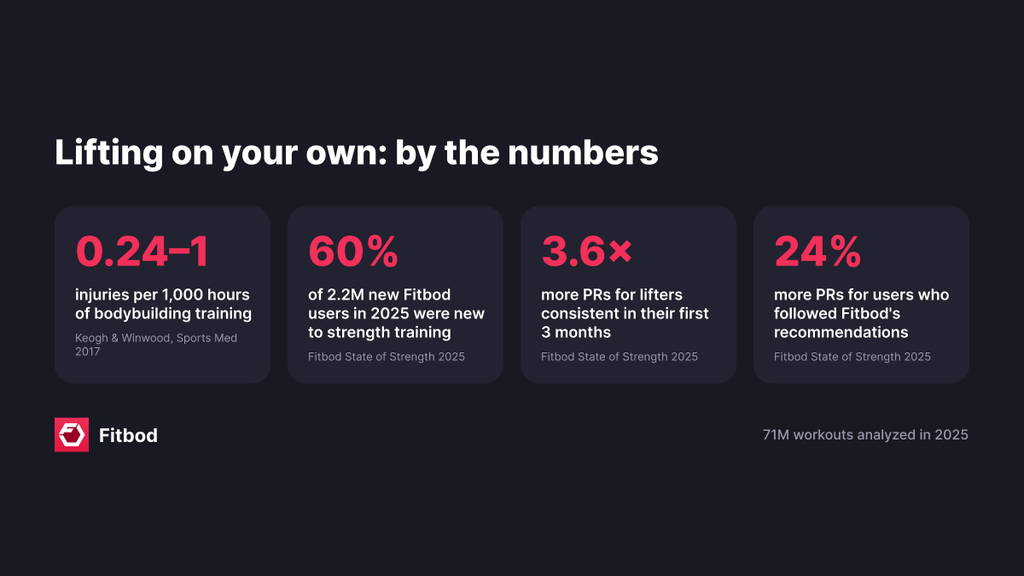
- Weight training has a relatively low injury rate. A review of the weight-training sports found 0.24 to 1 injury per 1,000 hours of bodybuilding training (Keogh and Winwood, Sports Medicine, 2017).
- Mayo Clinic advises starting with a weight you can lift comfortably 12 to 15 times, moving in a controlled way, and breathing out as you lift.
- Ending each set with 2 to 3 reps in reserve (RIR) keeps form clean while you learn, and the RIR scale is a validated way to rate effort (Zourdos et al., 2016).
- Progress in small steps. The American College of Sports Medicine (ACSM) recommends a 2% to 10% load increase once you can do one or two reps more than your target.
- Consistency matters more than intensity early on. In Fitbod’s 2025 data, lifters who trained consistently in their first three months set 3.6 times more personal records.
- Get help from a professional if you have a chronic health condition, or if an exercise causes pain.
Table of Contents
- Is it safe to learn to lift without a trainer?
- 1. Warm up before every session
- 2. Learn the movement before you load it
- 3. Start lighter than you think
- 4. Control every rep and breathe
- 5. Leave 2 to 3 reps in reserve
- 6. Film your sets to check your form
- 7. Add weight in small steps
- 8. Give each muscle about 48 hours to recover
- 9. Follow a structured, balanced plan
- 10. Know when to stop and get expert help
- What a trainer does, and how to replace it
- Frequently Asked Questions
- Final Thoughts
Is it safe to learn to lift without a trainer?
Yes, for most healthy adults. The ACSM’s 2026 position stand, which reviewed 137 systematic reviews covering more than 30,000 participants, states that “resistance training is safe for healthy adults of all ages.” The U.S. Physical Activity Guidelines add that the health benefits of physical activity “far outweigh the risks of adverse events for almost everyone.”
Injury data backs this up. A 2017 review in Sports Medicine concluded that “the weight-training sports appear to have relatively low rates of injury compared with common team sports.” The HHS guidelines also explain what drives the risk that does exist: injury risk “is directly related to the gap between a person’s usual level of activity and a new level of activity.” In plain terms, jumping from nothing to heavy is the problem, not training on your own.
You would also be in good company. Of the almost 2.2 million new Fitbod accounts created in 2025, 60% belonged to people who were new to strength training, according to the Fitbod 2025 State of Strength Report, which analyzed 71 million workouts and 2.8 billion logged sets.
1. Warm up before every session
Spend the first few minutes of every workout warming up, then do one or two light sets of your first lift. Mayo Clinic’s first rule of weight training is “Don’t skip the warmup,” because “cold muscles are more prone to injury than are warm muscles.”
The research on warm-ups points the same way. A meta-analysis found that warming up improved performance in 79% of the measures studied (Fradkin et al., 2010). For injury, the evidence is less certain, but an earlier review found that “the weight of evidence is in favour of a decreased risk of injury” (Fradkin et al., 2006).
- General warm-up: a few minutes of easy cardio such as walking or a stationary bike.
- Specific warm-up: one or two sets of your first exercise with an empty bar or very light dumbbells.
Fitbod can add warm-up sets and warm-up and cool-down routines to every workout, so you don’t have to plan them yourself.
2. Learn the movement before you load it
Practice each new exercise with no weight or very light weight until the movement feels smooth. Harvard Health notes that “many experts suggest starting with no weight, or very light weight,” and that “poor form can prompt injuries and slow gains.”
A trainer’s main job here is to show you what good form looks like. You can get that from a reliable demonstration. In a 2024 randomized trial of exercise novices, visual feedback improved how well people learned and retained the squat, and the authors recommend it “for squat acquisition and retention in exercise novices” (Shin et al., 2024).
Every exercise in Fitbod’s library of 1,000+ exercises includes a video demo and written form cues, according to Fitbod’s beginner guide. Watch the demo before your first set, then do a few practice reps with no weight.
Start with the basic movement patterns: a squat, a hip hinge (like a Romanian deadlift), a push (like a push-up or dumbbell press), and a pull (like a row or lat pulldown). Most other exercises build on these.
3. Start lighter than you think
Choose a starting weight you can lift comfortably 12 to 15 times. That is Mayo Clinic’s guidance for beginners, and the ACSM recommends that novices train in the range of an 8 to 12 rep maximum. Either way, your first sessions should feel easy.
Starting light is not wasted time. The ACSM’s 2026 position stand notes that for inexperienced lifters, “loads are necessarily low and progression is a requirement.”
Fitbod’s own data shows how often this goes wrong. In How to Start Strength Training From Zero, Fitbod notes that “most beginner injuries come from lifting too heavy too soon, not from a lack of coaching.”
4. Control every rep and breathe
Lift and lower the weight at a steady pace, and breathe out as you lift. Mayo Clinic advises moving the weight “in an unhurried, controlled fashion” and warns: “Don’t hold your breath. Instead, breathe out as you lift the weight and breathe in as you lower the weight.”
If you have to swing, jerk or bounce the weight to finish a rep, it is too heavy for now.
5. Leave 2 to 3 reps in reserve
End each set when you could still do 2 or 3 more good reps. This buffer is called reps in reserve (RIR), and it is the simplest way to protect your form while you are still learning. Fitbod’s beginner guide recommends finishing each set with 2 to 3 reps “still in the tank.”
RIR is a research-backed tool, not a guess. Zourdos and colleagues (2016) found that an RIR-based effort scale tracked bar speed closely, even in novices, and called it “a practical method to regulate daily training load.” Experienced lifters rate RIR more accurately, so expect your own estimates to improve over the first few weeks.
Avoid training to failure while you learn. The ACSM’s 2026 position stand cautions that lifting to fatigue is inadvisable for some groups because of an “increased risk of injury resulting from poor form.”
Fitbod lets you log your RIR after each set and uses it to judge how close you are to failure when it sets your next workout.
6. Film your sets to check your form
Prop up your phone, record a set from the side, and compare it with the exercise demo. This is the closest thing to having a coach watch you. British Weight Lifting, the governing body for weightlifting in the UK, says filming “creates an opportunity to identify what the athlete is doing well, as well as helping to identify areas of improvement.”
The research supports it. A small 2023 trial of 20 novices noted that “avoiding incorrect postures is challenging for novices without expert guidance,” and found squat posture improved when people got feedback.
What to look for in your video:
- Does the movement match the demo’s range of motion?
- Is your back in the same position at the bottom as at the top?
- Do your knees track in line with your toes on squats and lunges?
- Is the speed steady, without bouncing or jerking?
7. Add weight in small steps
Increase the weight only when your current weight feels easy for all your target reps, and keep each jump small. The ACSM recommends a 2% to 10% load increase “when the individual can perform the current workload for one to two repetitions over the desired number.” This approach is called progressive overload.
The U.S. Physical Activity Guidelines explain why small steps are safer: “small, progressive changes in overload help the body adapt to the additional stresses while minimizing the risk of injury.”
Small steps still add up. Fitbod data from 840,000 users and more than 10.5 million exercise logs shows a lifter with a 110 lb estimated one-rep max can typically reach 140 lb, a 27% increase, within 20 weeks (How Long Should Strength Gains Take?). You can also progress by adding reps instead of weight. Across more than 30 million progressions logged in Fitbod, about 70% added weight and 30% added reps (More Reps or More Weight?).
8. Give each muscle about 48 hours to recover
Train each muscle group 2 to 3 times per week, with about 48 hours between sessions for the same muscles. Harvard Health advises giving your muscles “at least 48 hours to recover,” and Mayo Clinic says to “avoid exercising the same muscles two days in a row.”
That schedule lines up with the guidelines. HHS recommends muscle-strengthening activities for all major muscle groups on 2 or more days a week, and the ACSM recommends 2 to 3 days a week for novices.
Fitbod tracks recovery for each muscle group from your logged workouts and favors fresher muscles in your next session. See Fitbod’s Muscle Recovery for how it works.
9. Follow a structured, balanced plan
Use a written plan that trains every major muscle group, rather than picking exercises at random. Without a plan, most people overtrain favorite muscles. Fitbod data shows that self-directed lifters train chest about 20% more often than back, “a recipe for imbalances and overuse injuries” (Do I Need a Structured Workout Program?).
A plan also keeps you consistent, which is where results come from. In the 2025 State of Strength Report:
- Users who trained consistently in their first three months set 3.6 times more personal records than those who did not.
- Users who followed Fitbod’s recommendations set 24% more personal records in 2025.
- 52% of beginner lifters trained at least twice a week, compared with 65% of advanced lifters.
The ACSM agrees that untrained people do well on many programs “provided that progression … and adherence are core principles.” Fitbod builds each workout around your goal, equipment, experience and recovery, then adjusts the next one based on what you logged. See how the Fitbod algorithm works.
10. Know when to stop and get expert help
Stop any exercise that causes pain, and see a health care provider before you start if you have a chronic condition. Mayo Clinic is direct: “If an exercise causes pain, stop.” Harvard Health adds that strength exercises “should not cause pain while you are doing them.” Effort and next-day soreness are normal; sharp or joint pain is not.
The American Academy of Orthopaedic Surgeons advises checking with your doctor before starting if you have a chronic health condition such as heart disease or diabetes. HHS likewise says people with chronic conditions or symptoms should be under the care of a health care provider.
Learning on your own doesn’t mean never getting help. Cleveland Clinic suggests partnering “with an athletic trainer, personal trainer or physical therapist” when you need guidance, and Harvard Health notes you can learn good form “through a class or one-on-one sessions with a certified exercise professional.” A single session to check your squat or deadlift can be a good investment. An app can’t fully replace that: as Fitbod says, it “can’t watch your form in real time.”
What a trainer does, and how to replace it on your own
| What a trainer gives you | How to get it without a trainer | Source |
|---|---|---|
| Shows you correct form | Watch a video demo, then practice with no weight | Harvard Health; Shin et al., 2024 |
| Watches your reps | Film a set from the side and compare it with the demo | British Weight Lifting; Shin et al., 2024 |
| Picks your starting weight | Start with a weight you can lift 12 to 15 times | Mayo Clinic |
| Tells you when to stop a set | End sets with 2 to 3 reps in reserve | Zourdos et al., 2016 |
| Decides when to add weight | Add 2% to 10% once you beat your target reps by 1 to 2 | ACSM, 2009 |
| Plans balanced weekly training | Follow a structured plan that trains all major muscles 2 to 3 days a week | HHS; ACSM, 2009 |
| Spots warning signs | Stop if an exercise causes pain; see a professional when needed | Mayo Clinic; AAOS |
Supervision does help some people progress faster, mainly because supervised lifters train harder (Mazzetti et al., 2000; Gentil and Bottaro, 2010). A plan that sets your weights and progression for you is one way to get that structure on your own.
Frequently Asked Questions
- Can a strength-training app be as effective as a personal trainer? For programming, often yes. An app can plan your workouts, set your weights and track your progress. Fitbod users who followed the app’s recommendations set 24% more personal records in 2025. An app can’t watch your form in real time, so film your sets and consider a session with a professional for complex lifts.
- How much weight should a beginner start with? Start with a weight you can lift comfortably 12 to 15 times, as Mayo Clinic recommends. For new exercises, practice with no weight or an empty bar first. Your last 2 to 3 reps should feel challenging but not sloppy. If your form breaks down before then, the weight is too heavy.
- How many days a week should a beginner lift weights? Two to three days a week. The U.S. Physical Activity Guidelines recommend muscle-strengthening activity for all major muscle groups on 2 or more days a week, and the ACSM recommends 2 to 3 days for novices. Leave about 48 hours between sessions that train the same muscles.
- How do I know if my lifting form is correct? Compare yourself with a reliable demo. Record a set from the side, then check your range of motion, back position, knee alignment and rep speed against the exercise video. Research on novices shows visual feedback improves how well people learn the squat. If an exercise causes pain, stop and get your form checked.
- Is muscle soreness after lifting a sign of injury? Usually not. Mild soreness a day or two after a new workout is normal and fades as your body adapts. Pain during an exercise is different. Mayo Clinic advises stopping any exercise that causes pain. Sharp, joint or lasting pain is a reason to see a health care provider.
- Should beginners lift to failure? No. While you are learning, end each set with 2 to 3 reps in reserve. The ACSM’s 2026 position stand notes that lifting to fatigue can raise injury risk through poor form in some groups. You can train closer to failure later, once your technique is consistent.
Final Thoughts
You don’t need a trainer to start lifting safely. You need the habits a good trainer would teach, and each rule above is backed by Mayo Clinic, the ACSM, U.S. health guidelines or peer-reviewed research. Fitbod handles the planning: it sets your weights, reps and recovery from more than 1,000 demo-backed exercises, so you can focus on lifting well. Try Fitbod free and start your first session with the rules above.
Sources
- Mayo Clinic Staff. Weight training: Do’s and don’ts of proper technique. Mayo Clinic. https://www.mayoclinic.org/healthy-lifestyle/fitness/in-depth/weight-training/art-20045842
- U.S. Department of Health and Human Services. Physical Activity Guidelines for Americans, 2nd edition. 2018. https://odphp.health.gov/sites/default/files/2019-09/Physical_Activity_Guidelines_2nd_edition.pdf
- Currier BS, et al. Resistance Training Prescription for Muscle Function, Hypertrophy, and Physical Performance in Healthy Adults: An Overview of Reviews (ACSM Position Stand). Med Sci Sports Exerc. 2026;58(4):851-872. doi:10.1249/MSS.0000000000003897. https://pmc.ncbi.nlm.nih.gov/articles/PMC12965823/
- American College of Sports Medicine. Progression models in resistance training for healthy adults. Med Sci Sports Exerc. 2009;41(3):687-708. doi:10.1249/MSS.0b013e3181915670. https://pubmed.ncbi.nlm.nih.gov/19204579/
- Keogh JW, Winwood PW. The Epidemiology of Injuries Across the Weight-Training Sports. Sports Med. 2017;47(3):479-501. doi:10.1007/s40279-016-0575-0. https://pubmed.ncbi.nlm.nih.gov/27328853/
- Paluch AE, et al. Resistance Exercise Training in Individuals With and Without Cardiovascular Disease: 2023 Update. A Scientific Statement From the American Heart Association. Circulation. 2024;149(3):e217-e231. doi:10.1161/CIR.0000000000001189. https://pmc.ncbi.nlm.nih.gov/articles/PMC11209834/
- Zourdos MC, et al. Novel Resistance Training-Specific Rating of Perceived Exertion Scale Measuring Repetitions in Reserve. J Strength Cond Res. 2016;30(1):267-75. doi:10.1519/JSC.0000000000001049. https://pubmed.ncbi.nlm.nih.gov/26049792/
- Helms ER, et al. Application of the Repetitions in Reserve-Based Rating of Perceived Exertion Scale for Resistance Training. Strength Cond J. 2016;38(4):42-49. https://pubmed.ncbi.nlm.nih.gov/27531969/
- Fradkin AJ, Zazryn TR, Smoliga JM. Effects of warming-up on physical performance: a systematic review with meta-analysis. J Strength Cond Res. 2010;24(1):140-8. https://pubmed.ncbi.nlm.nih.gov/19996770/
- Fradkin AJ, Gabbe BJ, Cameron PA. Does warming up prevent injury in sport? The evidence from randomised controlled trials? J Sci Med Sport. 2006;9(3):214-20. https://pubmed.ncbi.nlm.nih.gov/16679062/
- Shin HJ, Kim SH, Cho HY. The effect of types of sensory feedback on the acquisition and retention of squat performance: A randomized, double-blind, controlled trial. Scand J Med Sci Sports. 2024;34(1):e14531. https://pubmed.ncbi.nlm.nih.gov/37916599/
- Chae HJ, et al. An Artificial Intelligence Exercise Coaching Mobile App: Development and Randomized Controlled Trial to Verify Its Effectiveness in Posture Correction. Interact J Med Res. 2023;12:e37604. https://pubmed.ncbi.nlm.nih.gov/37698913/
- Mazzetti SA, et al. The influence of direct supervision of resistance training on strength performance. Med Sci Sports Exerc. 2000;32(6):1175-84. https://pubmed.ncbi.nlm.nih.gov/10862549/
- Gentil P, Bottaro M. Influence of supervision ratio on muscle adaptations to resistance training in nontrained subjects. J Strength Cond Res. 2010;24(3):639-43. https://pubmed.ncbi.nlm.nih.gov/19661830/
- Harvard Health Publishing. 8 tips for safe and effective strength training. 2024. https://www.harvardhealth.org/healthy-aging-and-longevity/8-tips-for-safe-and-effective-strength-training
- Harvard Health Publishing. Six tips for safe strength training. 2017. https://www.harvardhealth.org/healthy-aging-and-longevity/six-tips-for-safe-strength-training
- Harvard Health Publishing. 7 tips for a safe and successful strength-training program. 2015. https://www.harvardhealth.org/exercise-and-fitness/7-tips-for-a-safe-and-successful-strength-training-program
- American Academy of Orthopaedic Surgeons (OrthoInfo). Starting a Strength Training Program. https://www.orthoinfo.org/staying-healthy/fitness–exercise/starting-a-strength-training-program/
- Cleveland Clinic. Weightlifting 101. 2025. https://health.clevelandclinic.org/weightlifting
- British Weight Lifting. Good or bad? Filming your lifts in training. 2023. https://britishweightlifting.org/article/good-or-bad-filming-your-lifts-in-training
- Fitbod. State of Strength Report 2025. https://fitbod.me/blog/fitbod-2025-state-of-strength-report/
- Fitbod. How to Start Strength Training From Zero. https://fitbod.me/blog/how-to-start-strength-training-from-zero/
- Fitbod. How Do I Start Strength Training When I Have No Idea What I’m Doing? https://fitbod.me/blog/how-to-start-strength-training-with-no-experience/
- Fitbod. How Long Should Strength Gains Take? https://fitbod.me/blog/how-long-should-strength-gains-take/
- Fitbod. More Reps or More Weight? https://fitbod.me/blog/more-reps-or-more-weight-progressive-overload/
- Fitbod. Do I Need a Structured Workout Program? https://fitbod.me/blog/do-i-need-a-structured-workout-program/
- Fitbod. How Fitbod Personalizes Your Workout Plan. https://fitbod.me/blog/how-fitbod-personalizes-your-workout-plan-using-smart-training-algorithms/


